
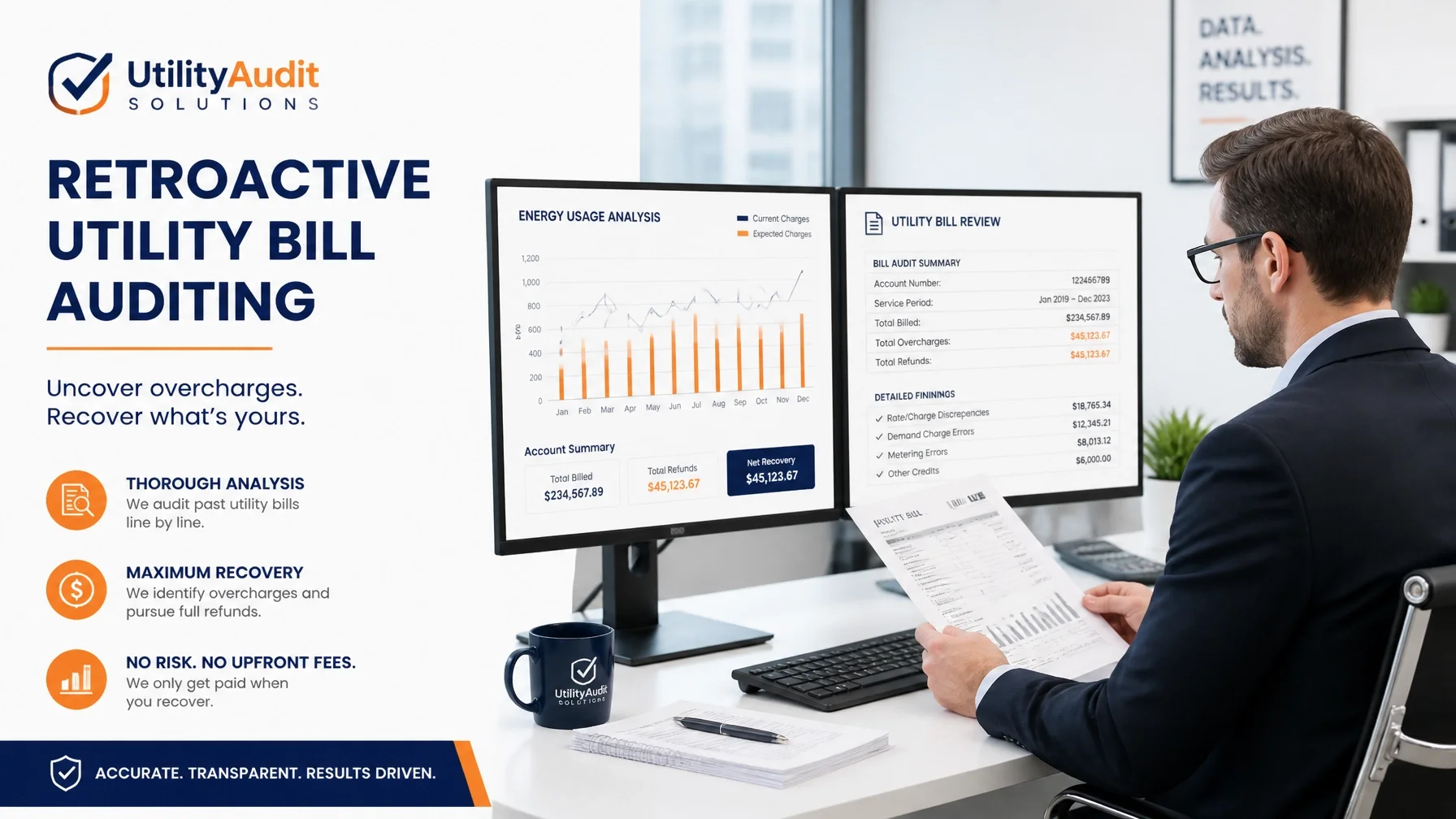
If you run a business in New Jersey, you scrutinize your expenses. You negotiate vendor contracts, review payroll weekly, and monitor supply chain costs down to the penny. Yet, there is a hidden leak in your balance sheet that you are likely ignoring every single month: your utility bills.
Industry data reveals a staggering statistic: up to 80% of businesses overpay on their utility bills. Even more shocking is that between 1% and 5% of all historical utility spend represents pure, unadulterated overcharges: money paid out for services never received, incorrect tax classifications, or phantom meter readings.
For a mid-sized restaurant group, a hotel property, or a manufacturing plant in NJ, this translates to thousands: sometimes tens of thousands: of dollars sitting in utility company coffers. At United Energy Consultants (UEC), we help businesses secure competitive energy rates, but procurement is only half the battle. If you haven’t audited what you've already paid over the last 12 to 36 months, you are leaving hard-earned capital on the table.
In this guide, we break down how retroactive utility bill audits work, the most common errors draining your accounts, and how you can recover your money with zero upfront risk.
1. What Is a Retroactive Utility Bill Audit and Why Do You Need One?
A retroactive utility bill audit is a forensic, line-by-line examination of your past electricity, natural gas, water, and sewer invoices: typically looking back 12 to 36 months (and up to 6 years where local regulations allow).
Unlike facility energy efficiency upgrades or LED retrofits that require capital expenditure, a retroactive audit is purely a paper trail and data review. Auditors cross-reference your historical bills against complex utility tariffs, regulatory rate codes, historical meter data, and your existing energy contracts.
Why is this essential for your business? Utility companies are massive, bureaucratic entities. Their billing systems are prone to human and algorithmic errors. When an error is introduced into your billing profile: such as an incorrect commercial rate classification: the utility will happily continue billing you incorrectly month after month until someone catches it. Because most business owners assume utility bills are infallible, these errors persist silently for years.
2. The 6 Most Common Billing Errors Draining Your Business Energy Costs in NJ
When our team at UEC conducts audits for commercial clients across New Jersey, we routinely uncover specific, recurring billing discrepancies. Here are the most frequent culprits behind inflated business energy costs NJ businesses face:
Incorrect Rate Classifications: Being assigned to the wrong commercial or industrial rate class, or failing to transition to an optimized time-of-day pricing schedule.
Misapplied Taxes & Missing Exemptions: Paying state sales tax on energy usage when your business qualifies for a manufacturing, agricultural, or non-profit exemption.
Meter Reading and Multiplier Errors: Flawed meter multipliers or estimated readings that grossly overstate your actual consumption.
Expired Contract Terms: Continuing to be billed at out-of-contract default rates long after a fixed-price agreement expired.
Duplicate and Phantom Charges: Being billed for inactive meters, backup feeds that are never energized, or overlapping billing cycles.
Demand Charge Miscalculations: Peak demand spikes incorrectly calculated due to meter recording errors or faulty interval data.
3. How the Contingency Model Makes It Completely Risk-Free
One of the biggest hesitations business owners have is the perceived cost and disruption of hiring an auditing firm. They worry about billable hours, diverting internal accounting staff, and paying fees for a report that might yield nothing.
The beauty of a professional utility audit is the contingency pricing model (no-find, no-fee).
Reputable energy consultants and audit specialists do not charge upfront retainer fees. Instead, they operate on a shared-savings contingency structure:
Zero Out-of-Pocket Cost: You authorize the audit by signing a Letter of Authorization (LOA) allowing access to historical billing records.
Expert Forensic Review: The audit team does all the heavy lifting, pulling invoices, interacting with utility reps, and filing refund claims.
Recovery & Split: If no overcharges are found, you owe nothing. If refunds or bill credits are recovered from the utility, the fee is a percentage of the actual money put back into your bank account.
In short: you only pay when you win. For real estate firms looking at reducing energy costs for real estate companies, this represents pure bottom-line recovery with zero capital risk.
4. Protecting Hotels, Real Estate, and Manufacturers: Industry-Specific Vulnerabilities
Different commercial sectors face unique utility billing vulnerabilities:
Hotel & Hospitality Management: Hotels manage massive footprints with complex HVAC, laundry, and kitchen loads. Without proper oversight, multi-meter properties frequently experience misapplied tariffs across different functional areas. Utilizing dedicated tools: as explored in our guide on hotel utility management software: helps hospitality groups maintain total visibility.
Commercial Real Estate: Multi-tenant office and retail buildings juggle common-area maintenance (CAM) charges and submetered tenant billing. A single uncorrected rate error across a portfolio can cost landlords tens of thousands annually.
Manufacturing & Industrial Plants: High-energy users are particularly vulnerable to demand charge errors and tax exemption oversights.
5. From Retroactive Recovery to Ongoing Prevention with Energy Tracker Pro
Recovering thousands of dollars in past overcharges is a massive win, but what happens the day after the audit concludes? Without continuous monitoring, new billing errors can creep back onto your invoices within months.
This is where proactive management bridges the gap. At United Energy Consultants, we pair our comprehensive procurement and auditing expertise with our proprietary software, Energy Tracker Pro.
Energy Tracker Pro acts as your digital watchdog, providing:
Automated Invoice Auditing: Scanning every incoming utility bill for anomalies, rate creep, and multiplier shifts before payment is issued.
Real-Time Consumption Analytics: Tracking usage trends across single or multi-site portfolios in deregulated markets.
Budget Forecasting: Giving business owners precise visibility to plan short- and long-term energy expenditures with confidence.
Take Action Today: Claim Your Hidden Refunds
You've already paid for your energy: isn't it time to make sure you didn't pay too much?
Whether you operate a restaurant group, a manufacturing facility, a hotel portfolio, or commercial real estate in NJ, a retroactive utility bill audit uncovers hidden money without disrupting your operations.
Ready to uncover what the utility companies owe you?Contact United Energy Consultants today to schedule your risk-free utility audit and discover how our independent procurement strategies and Energy Tracker Pro software can protect your bottom line today and tomorrow. Explore more insights on our UEC Blog.