

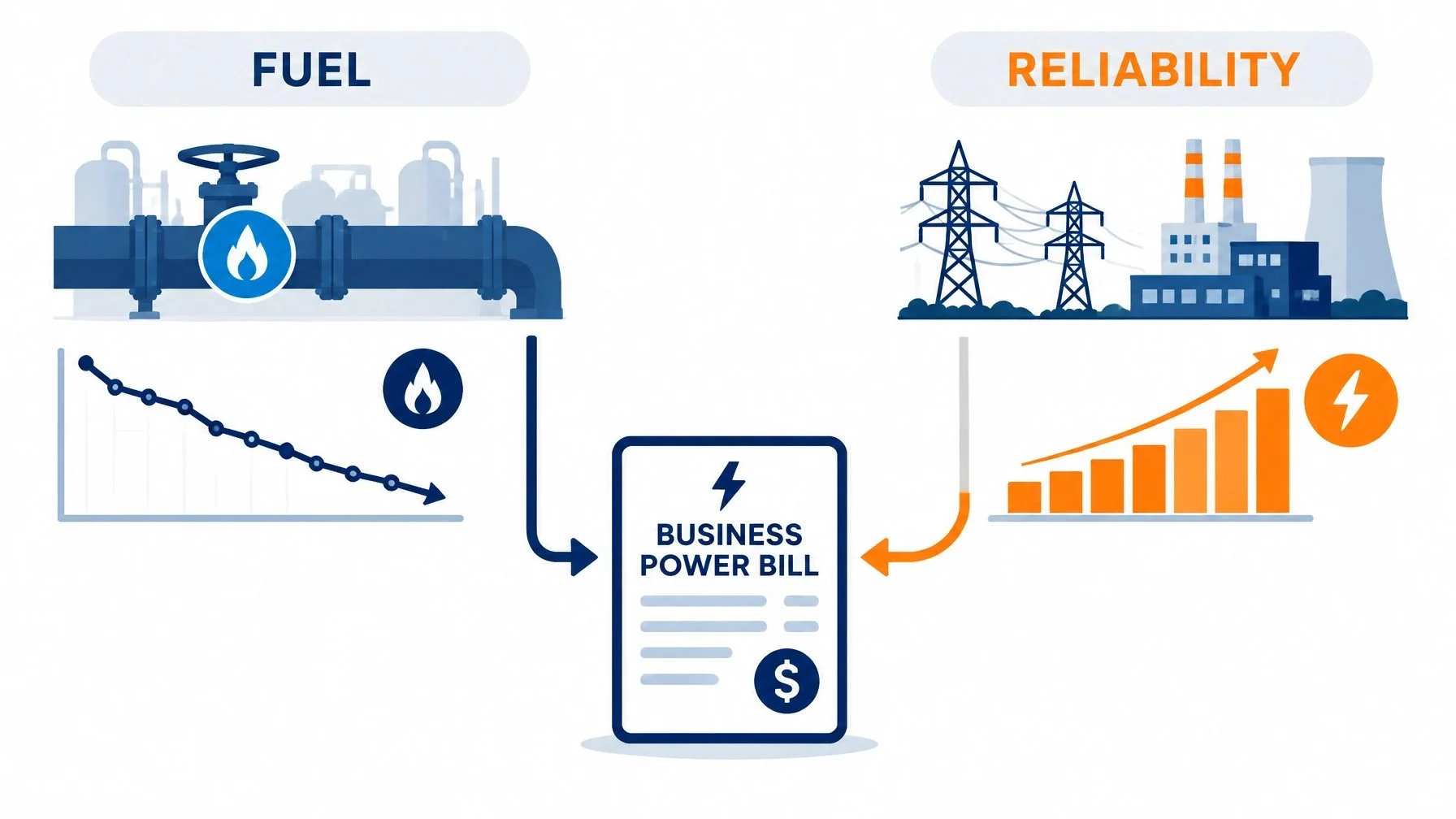
Henry Hub natural gas is near $2.77/MMBtu, U.S. production is about 101.5 Bcf per day, and gas storage reached 3,785 Bcf for the week ending October 18, 2026-an 80 Bcf weekly injection and above the five-year average. Those are comparatively soft fuel-market signals. They do not mean that a business’s electricity bill will fall by the same amount.
In the PJM region, the price of electricity supply and the cost of maintaining reliability are responding to different pressures. Capacity costs, rapid large-load growth and questions about how those costs will be allocated remain significant factors for businesses planning winter and future contract renewals.
1. The winter fuel outlook is mild, but it is not a commercial power-rate forecast
The U.S. Energy Information Administration’s October 7, 2026 Winter Fuels Outlook projects that household heating bills will move in different directions this winter. Electricity-heated households, more than 40% of U.S. homes, are forecast to spend about 4% more than last winter. Natural-gas-heated households are forecast to spend about 9% less, while heating-oil-heated households face a projected 21% increase. EIA also expects a warmer-than-normal winter in the Northeast.
These are household heating expenditure estimates, not forecasts of business electricity supply prices. But they illustrate the central point: lower natural gas costs do not automatically reduce every energy bill. Electricity costs also reflect grid conditions, capacity procurement, delivery and a business’s load profile.
As of October 27, Henry Hub front-month gas is around $2.77/MMBtu. Gas-fired power burn declined 5.7% week over week, according to the late-October market data. The fuel picture looks comparatively comfortable; the reliability picture is more complicated.
2. PJM reliability costs are sending a different signal
PJM’s 2028/29 Base Residual Auction procured 138,318 MW of unforced capacity, leaving a 6,831 MW shortfall against the reliability requirement. The auction cleared at the $325/MW-day price cap. PJM reported approximately $16.4 billion in capacity commitments.
One important price distinction: PJM’s auction report also presents an uncapped simulation. In that scenario, the modeled price is $554.72/MW-day across the system, except ComEd at $776.69/MW-day. Those figures are not the auction’s actual cleared prices; they indicate what the model estimates without the cap. The distinction matters when comparing a market signal with a charge actually established by the auction.
Near-term energy pricing can also vary from capacity signals. A PJM Western Hub spot assessment of $265.40/MWh was reported for October 25. Because that date was a Sunday, the figure should be treated as an assessment rather than a standard weekday trading-session settlement. One spot assessment does not describe a business’s annual contract cost, but it illustrates that hourly energy, future capacity and fuel prices are separate measures.
The market monitor’s report for the first quarter of 2026 found total PJM wholesale power costs rose 75.5% year over year, from $77.78/MWh to $136.53/MWh. Capacity’s component rose 398.1%. The report identifies data-center load growth as the primary reason for tight capacity-market conditions and high capacity prices; it does not attribute the entire increase in total wholesale cost to data centers.

3. The issue is who funds new reliability, and how that cost is assigned
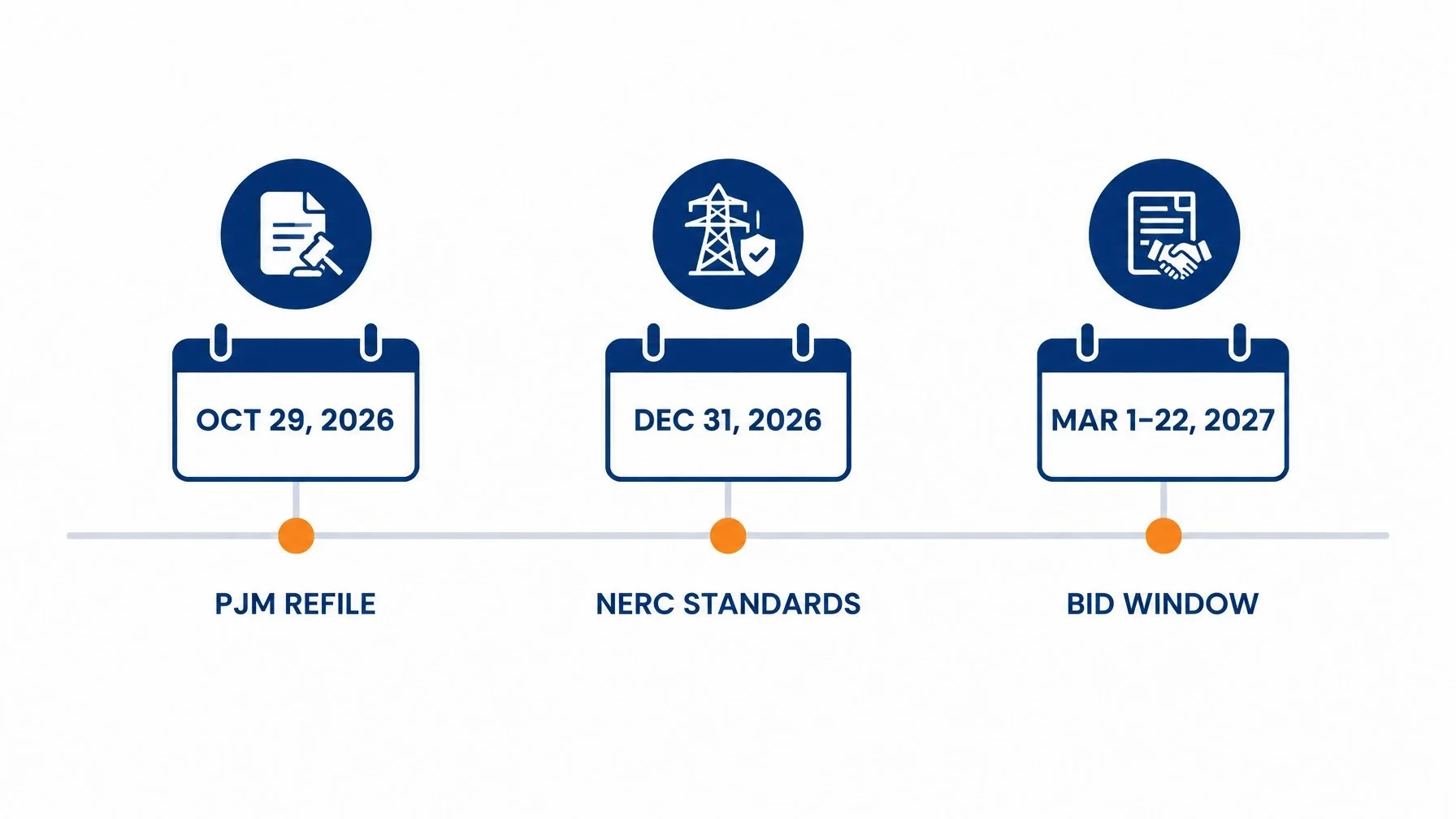
On September 29, FERC suspended implementation of PJM’s proposed Reliability Backstop Procurement while addressing concerns about cost allocation, LSE exit responsibilities and collateral. PJM plans to refile tariff revisions by October 29.
The proposed revised approach would allocate costs among zones based on each zone’s share of large-load growth between the 2026/27 and 2028/29 delivery years. Customer-level offsets are also contemplated. The method is still under review; the final filing and FERC action will determine how the procurement and related obligations are structured.
The planned bid window is March 1–22, 2027. PJM’s proposal includes contracts of up to 15 years and a $555/MW-day cap on the weighted-average procurement cost. That cap is a procurement limit, not a forecast of every business’s retail rate.
DOE’s October 7 filing urged PJM to ensure that large loads, not existing households and businesses, fund the generation and infrastructure required to serve them. The policy debate is about cost causation: which customers and zones are responsible for the new requirements, and how the corresponding costs should be allocated.
For business customers, this matters because the final allocation could influence future regional costs even when the fuel market is relatively well supplied.
4. Local bills show why the distinction matters
New Jersey’s BPU has identified PJM capacity prices as the main driver of estimated residential bill increases of $22.67 to $28.02 per month in the relevant rate proceedings. In Pennsylvania, the average residential monthly bill increased from $106.03 in 2020 to $166.73 in 2025.
These are residential benchmarks, not direct forecasts for a commercial account. They do show that changes in reliability and supply costs can affect bills independently of whether natural gas prices are rising or falling.
The cost of adding supply is also a constraint. LS Power COO Darpan Kapadia told Utility Dive on October 20 that building a 1 GW combined-cycle plant now costs “north of $3 billion”, roughly twice the cost six to seven years ago. Higher project costs do not set a particular customer’s rate, but they inform the economics of adding resources to a market facing demand growth.
5. What businesses can do before the filing and bid window
The October 29 filing and March 2027 bid window are milestones for the market, not reasons to postpone procurement planning. Businesses can use the time to understand their existing contracts, load and exposure.
Check contract dates across every location. Identify expiration dates, renewal windows and notice deadlines, especially where sites operate in different utility territories.
Review 12–24 months of usage and interval data. Seasonal consumption, operating hours, peak demand and planned expansions can affect how suppliers evaluate a load.
Compare pricing on consistent assumptions. Check contract term, usage profile and which price components the offer covers; a headline rate alone is not a complete comparison.
Evaluate a fixed-price supply contract when budget certainty is a priority. A fixed price can protect the contracted supply price from commodity-market movement; it does not necessarily fix every utility or grid charge.
Revisit the analysis as PJM’s proposal develops. The October 29 filing and March 1–22, 2027 bid window may clarify cost-allocation and procurement details, but they do not establish that every commercial customer will pay the same amount.
6. Track actual usage, not just the gas headline
The EIA outlook and late-October gas data point to a comparatively well-supplied fuel market. PJM’s capacity shortfall, large-load growth and pending reliability procurement point to a separate cost challenge. Both signals can be true at once.
United Energy Consultants helps businesses assess usage data, negotiate energy contracts and develop custom buying strategies. Its Energy Tracker Pro software supports utility management and visibility across accounts. UEC is independent, has no supplier affiliations, works across deregulated states and has more than 20 years of industry experience; its services come with zero out-of-pocket costs to clients.
Businesses reviewing business energy costs in NJ, deregulated energy states energy buying strategies, or wholesale energy rates for manufacturers can explore Energy Tracker Pro, review UEC’s guidance on deregulated energy buying strategies, and contact United Energy Consultants to discuss contract timing and a fixed-price strategy.
Sources
PJM, October 22 stakeholder presentation on the upcoming Reliability Backstop Procurement filing
FERC Order RD26-7-000 on computational-load reliability standards, July 16, 2026
Monitoring Analytics, PJM Q1 2026 State of the Market Report
U.S. Department of Energy filing on PJM’s Reliability Backstop Procurement, October 7, 2026