

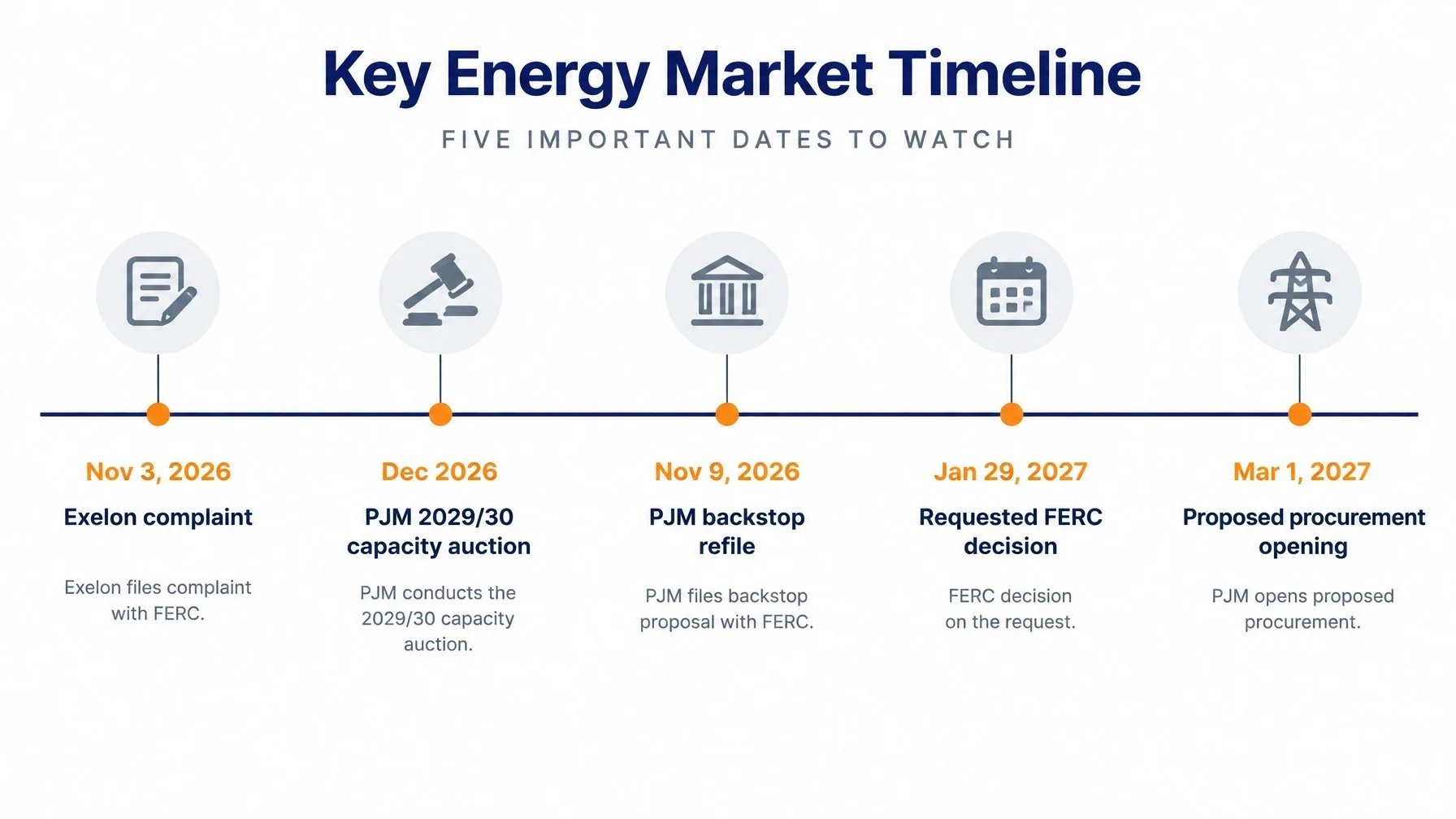
PJM’s capacity auction schedule is now at the center of a FERC complaint. On November 3, 2026, Exelon asked the Federal Energy Regulatory Commission to replace PJM’s three-year-forward capacity auction with a “prompt” auction held about two months before each delivery year. The debate comes as natural gas prices remain soft, while businesses still face a December capacity auction and uncertainty over future reliability costs.
1. Exelon asks FERC to move the auction closer to delivery
In its complaint in Docket EL27-11-000, filed November 3 and announced November 4, Exelon argues that PJM’s current Reliability Pricing Model (RPM) auction is no longer just and reasonable. Exelon proposes starting a prompt-auction structure with the 2030/2031 delivery year.
Under the current schedule, that delivery year’s Base Residual Auction (BRA) is expected in May 2027. Exelon’s proposal would move it to approximately March 2030, about two months before the delivery year begins. The company argues that the existing system prices capacity using “parameters estimated four years in advance of delivery” and forces utilities to “predict reality years in advance.”
Exelon requests expedited FERC review, a decision by January 31, 2027, and a refund-effective date of January 1, 2027. PJM opposes fast-track treatment, arguing that a change to core market rules requires broader stakeholder input. Exelon says its proposal is “targeted surgery” that “will not heal all that ails RPM,” and acknowledges PJM still urgently needs more generation.
For your business, the proposal is not a settled rule change. It is a regulatory dispute that could affect the timing and information used to price future capacity. It does not put the December 2026 auction on hold.
2. The December auction and reliability backstop remain on the calendar
The 2029/2030 delivery-year BRA is scheduled for December 2026, with the auction set to close on December 15. It is also the final auction under the price collar: the cap is $337.83/MW-day and the floor is $181.91/MW-day, with PJM intending to return to its standard three-year-forward schedule without a collar for the 2030/2031 delivery year. Exelon’s complaint does not seek to disrupt that auction, or any Reliability Backstop Procurement auction.
Separately, on November 9, PJM submitted an amended Section 205 filing in Docket ER27-454, addressing collateral and exit rules for its Reliability Backstop Procurement. PJM asks FERC to issue an order by January 29, 2027; if approved, the procurement process would open March 1, 2027.
The potential procurement amount is also uncertain:
PJM’s initial backstop target was approximately 6,800 MW.
A October 28 Jefferies note, reported by Utility Dive, said updated large-load forecasts from PPL Electric, FirstEnergy and AES Ohio cut near-term forecasts by a combined 6.5 GW. Jefferies estimated the target could fall to as little as 630 MW.
On November 2, Charles River Associates told PJM’s Load Analysis Subcommittee that a constrained-supply scenario could still leave the region with an approximately 11.5 GW shortfall by 2030.
These numbers describe different assumptions and time horizons; the possible near-term backstop reduction does not erase longer-range supply concerns.
3. Natural gas is soft, but the winter picture can change
The near-term gas market is comparatively subdued. According to WoodRiver Energy’s November 6 weekly update, NYMEX Henry Hub December futures settled at $2.947/MMBtu on November 5, essentially flat from a week earlier. January settled at $3.413/MMBtu, about 47 cents above December, while March settled at $2.399/MMBtu. Henry Hub cash was $2.625/MMBtu.
The Energy Information Administration (EIA) reported a 77 Bcf injection for the week ended October 30, versus a five-year average injection of 61 Bcf and 39 Bcf a year earlier. Working gas reached 3,801 Bcf-54 Bcf, or 1.4%, above the five-year average, but 109 Bcf, or 2.8%, below year-ago levels.
Weather and supply reinforce the softer outlook, though forecasts are not guarantees:
NOAA’s 6–10 day outlook favors above-normal temperatures across much of the West and near-normal temperatures across much of the East, with parts of New England leaning below normal. WoodRiver reported forecasts for very mild weather into Thanksgiving.
On November 10, the EIA projected Henry Hub would average $2.87/MMBtu from November through March, 16% below its previous projection. The EIA cited a warm start to November, higher-than-expected inventories and an El Niño-influenced outlook favoring warmer-than-average conditions across much of the northern United States.
Targa Resources reported record third-quarter Permian volumes of 7.5 Bcf/d, up 14% year over year. WoodRiver also cited approximately 13 Bcf/d of new Permian pipeline capacity expected over the next several years.
Continued warmth could erode the winter risk premium in gas prices. It does not resolve PJM’s separate capacity and reliability questions.

4. Soft gas does not settle capacity costs
Electricity supply and capacity are related, but they are not the same market signal. Natural gas prices influence the cost of fuel for many generators; capacity payments compensate resources for being available to support reliability when needed. A decline in gas prices does not automatically reduce capacity costs.
PJM’s 2028/2029 BRA cleared at the $325/MW-day price cap, while the region continues to face rapid data-center demand growth and supply constraints. Exelon’s warning is that under the existing forward schedule, customers could face what it calls an “uncapped surge in capacity prices expected this coming spring.” That is Exelon’s argument in its complaint, not a final FERC finding or a certainty about future prices.
If you are comparing business energy costs NJ, separate the commodity price from capacity and reliability cost components. A soft wholesale gas curve may create an opportunity to evaluate a fixed-price supply contract, but it does not guarantee every component of a business’s electricity bill will move in parallel.
5. Six checks to make before you sign
The market rules are unsettled; your procurement data and contract calendar are within your control. Before renewing or signing in 2026, consider this checklist:
Confirm expiration dates for every meter. A multi-site portfolio may have different terms, utilities and renewal windows.
Gather 12–24 months of interval data. Usage patterns, peak demand and seasonal changes help suppliers evaluate your load more accurately.
Compare fixed-price offers using consistent assumptions. Match the load profile, contract term and pricing scope before comparing quotes.
Choose a term that reflects your risk view. Consider how much certainty you want while FERC reviews auction design and PJM’s backstop rules.
Track the key dates. Monitor the December 2026 BRA result and PJM’s requested January 29, 2027 FERC decision date for the backstop filing.
Review expansion plans and load exposure. New equipment, production shifts, hotel renovations or data-center growth can change the buying profile.
For state-by-state context, see UEC’s guide to deregulated energy states and energy buying strategies. Businesses evaluating wholesale energy rates for manufacturers, hotel utility management software or data center energy management strategies can benefit from a consistent view of usage, contract dates and facility needs.
6. You cannot control FERC’s calendar, but you can control yours
The December 2026 auction, the PJM backstop filing and Exelon’s complaint are distinct proceedings. Their outcomes may influence future market costs and procurement schedules, but they do not remove the value of planning ahead. A fixed-price contract can protect the contracted supply price while forward curves are soft, provided the term and assumptions fit your facilities and renewal dates.
Keeping usage, costs and contract expiration dates visible across every facility makes it easier to act on those dates instead of after them. United Energy Consultants is independent, has no supplier affiliations, works across deregulated states, and brings more than 20 years of experience. UEC’s consulting services come with zero out-of-pocket costs to clients.
Contact United Energy Consultants to review your contract calendar, usage data and fixed-price options.
Sources
Energy Choice Matters, Exelon complaint coverage, November 5, 2026
PJM amended Section 205 filing, Docket ER27-454-000, November 9, 2026
Jefferies forecast revisions reported by Utility Dive, November 3, 2026
Charles River Associates presentation to PJM’s Load Analysis Subcommittee, November 2, 2026