
FERC Just Suspended PJM's Backstop Auction: What the 5-Month Delay Means for NJ Business Energy Costs This Winter

The PJM Reliability Backstop Procurement auction was scheduled to open on September 30, 2026. It did not open.
On September 29, the Federal Energy Regulatory Commission accepted PJM’s one-time backstop filing but suspended implementation for five months, establishing an effective date of February 28, 2027, subject to refund and further proceedings.
The auction was designed to address a 6,831.3 MW reliability shortfall. PJM has not published a new bid-window timeline. The delay is not a cancellation, but it moves the procurement into a substantially tighter window before the 2028/29 delivery year begins on June 1, 2028.
For businesses evaluating business energy costs NJ, the immediate conclusion is straightforward: the suspension does not reduce current electricity bills. Capacity costs for already-cleared delivery years remain in place, while the future cost allocation and supply outlook remain unresolved.
1. What FERC Decided on September 29
FERC issued Order 196 FERC ¶ 61,245 in Docket No. ER26-3380-000. The order:
Accepted PJM’s Reliability Backstop Procurement filing for consideration.
Suspended implementation for five months.
Set the effective date at February 28, 2027.
Made the suspension subject to refund and the outcome of further procedures.
Established a paper hearing.
Opened a companion Federal Power Act Section 206 investigation in Docket No. EL26-108-000.
FERC found that PJM had not demonstrated that three major components were just and reasonable:
Cost allocation
Transmission owner exit rules
Load-serving entity collateral requirements
FERC also rejected PJM’s proposal to allow qualifying cooperatives and municipal utilities to opt out of the backstop.
FERC Chairman Laura Swett stated that the Commission would not accept “a deeply flawed, eleventh-hour procurement mechanism with billion-dollar implications for consumers.” PJM spokesman Jeffrey Shields said PJM is reviewing the order and will work quickly to address the remaining concerns. No new auction timeline has been published.
PJM is scheduled to give an administrative update at its Market Implementation Committee on October 7, 2026.
2. The Three Issues That Stopped the Auction
Cost allocation
PJM proposed assigning backstop costs primarily according to forecasted load growth by transmission zone and area. FERC found that the approach may not accurately capture which loads create the reliability requirement.
The concern is material because the allocation could remain fixed across contracts lasting up to 15 delivery years, even if actual load growth differs from the original forecast.
FERC identified an alternative based on updated load forecasts and current resource information. That approach could better connect costs to the customers and zones driving the capacity need.
Transmission owner exit rules
PJM proposed requiring a transmission owner that exits PJM before backstop costs are recovered to preserve the associated commitments or pay obligations connected to the resources.
FERC found that these costs should generally be assigned to the load-serving entities within the transmission zone, rather than to the transmission owner itself. The reasoning is that LSEs are the buyers for whom PJM procures capacity and are the parties serving the load that benefits from the procurement.
LSE collateral
PJM proposed a buyer-side collateral rate of approximately $1.5 million per committed MW. Northern Virginia Electric Cooperative indicated that its collateral requirement could reach approximately $2 billion.
FERC concluded that PJM had not provided enough evidence to show that the requirement appropriately balances market protection with liquidity and operational flexibility for LSEs.
FERC found the proposed supplier collateral structure appropriate but questioned the buyer-side requirement, including its timing, calculation, and acceptable forms of credit support.
3. Why the Suspension Does Not Lower Your Winter Bill
The backstop auction was a future procurement mechanism. It was not a refund process for capacity already purchased through PJM’s Base Residual Auctions.
The relevant capacity prices are already established:
2026/27 delivery year: $329.17/MW-day across PJM zones, including New Jersey.
2027/28 delivery year: approximately $333.44/MW-day, based on the prior auction results.
2028/29 delivery year: $325/MW-day, the FERC-approved cap at which the auction cleared.
The 2026/27 price is approximately 20% above the prior year’s $269.92/MW-day. New Jersey’s temporary state offsets and bill credits approved by the NJBPU on September 24, 2026 moderate how those costs appear on customer bills during winter 2026–2027. They do not remove the underlying PJM capacity obligation.
The suspension also does not guarantee lower future costs. It delays the procurement intended to add supply to a system that already failed to meet its reliability requirement.
4. The Capacity Gap and the Backstop Cost Math
PJM’s 2028/29 Base Residual Auction, announced July 14, 2026, procured:
138,318 MW of unforced capacity.
10,864 MW of Fixed Resource Requirement resources.
A clearing price of $325/MW-day.
Approximately $16.4 billion in total capacity commitments.
A 14.7% reserve margin.
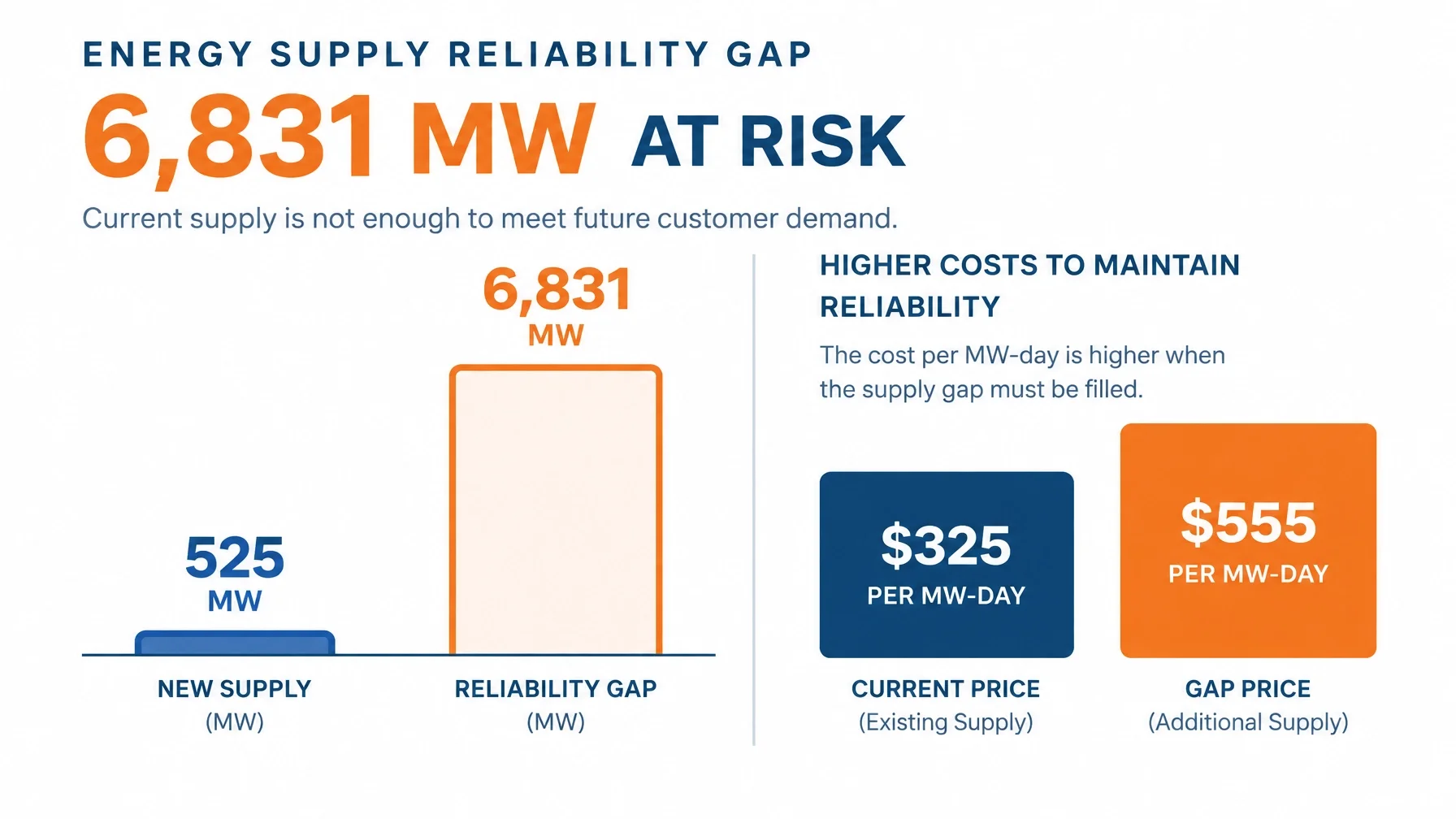
A remaining reliability shortfall of 6,831 MW.
Only 525 MW of new generation and uprates cleared. That represents 7.7% of the capacity that was missing.
The prior 2027/28 auction also missed its reliability requirement by approximately 6,500 MW. These are the first two auctions in PJM history in which the entire RTO missed its reliability requirement.
The backstop filing proposed:
A target of 6,831.3 MW UCAP.
A maximum MW-weighted average levelized offer of $555/MW-day.
Contracts lasting up to 15 delivery years.
Resources entering service as late as June 1, 2032.
At the offer cap:
6,831.3 MW × $555 × 365 days = approximately $1.38 billion per delivery year.
A flat, undiscounted 15-year total equals approximately $20.8 billion.
A 100 MW obligation costs approximately $20.3 million per year at $555/MW-day, compared with approximately $11.9 million at $325/MW-day.
The backstop represents approximately 4.9% more procured megawatts, but approximately 8.4% more annual capacity cost, because the proposed price limit is 71% above the $325 auction cap.
These figures represent an upper-bound scenario because the $555 limit applies to weighted-average levelized offers. The final procurement cost remains unknown.
5. Data Center Growth Is the Structural Driver
PJM’s filing forecasts peak load growth of 32 GW between 2024 and 2030. Approximately 30 GW of that growth is attributed to data centers.
PJM’s board has also cited approximately 70 GW of new large load by 2038, compared with 15 GW of generation retired since 2022.
The Independent Market Monitor reports data center peak load rising from:
5,036.9 MW in 2023
6,135.6 MW in 2024
8,167.2 MW in 2025
That is a 62% increase from 2023 to 2025. The Monitor’s table lists 93,916.3 MW of data center peak load expected to be operating by June 1, 2031.
The Monitor’s September 3 protest also claims that data center load has added $29.4 billion to capacity costs and that curtailed data centers could receive compensation at 50% of the non-performance charge rate, paid by other customers. These are the Monitor’s positions, not FERC findings.
The data establishes the market context: business customers are managing capacity costs while PJM, states, utilities, and large-load developers continue to dispute who should pay for new infrastructure and procurement.
6. The Parallel IRAS Track Adds Curtailment Risk
PJM’s Interim Resource Adequacy Service proposal, filed August 13, 2026, in Docket No. ER26-3515, creates a separate risk for large new loads.
The proposal would:
Apply to new loads of 50 MW or more that bring no new capacity.
Place those loads first in line for curtailment beginning with the 2027/28 delivery year.
Exclude them from capacity procurement targets beginning in 2029/30.
Seek a FERC decision date of October 12, 2026.
If IRAS advances while the backstop remains delayed, developers that cannot self-supply or secure qualifying capacity may face curtailment exposure before the backstop delivers new resources.
The backstop tariff also permits resources to enter service as late as June 1, 2032. Therefore, even if PJM completes the procurement, it does not guarantee that all selected resources operate during the 2028/29 delivery year they are intended to support.
7. A Practical Winter 2026–2027 Procurement Plan
Your business should not wait for the next PJM headline before reviewing its position. A practical plan includes:
Confirm contract expiration dates by facility
Review every electricity and natural gas account.
Identify expirations, renewal windows, evergreen clauses, and termination notice requirements.
Analyze 12–24 months of interval usage
Separate seasonal consumption from operating changes.
Identify abnormal peaks, production shifts, occupancy changes, and weather-driven demand.
Check capacity tags and peak-demand exposure
Review PLC values, transmission charges, demand ratchets, and coincident peak exposure.
Identify whether a single operational event could increase future capacity-related costs.
Lock appropriate winter blocks before the next major market announcement
Restaurants, hotels, manufacturers, cannabis facilities, and data centers often have different load shapes.
A single fixed-price structure may not match the risk profile of every facility.
Stagger purchases across term lengths
Use a combination of near-term and longer-term blocks where appropriate.
Avoid concentrating all purchasing decisions on one market day or one contract expiration.
Re-run the analysis when PJM refiles
Recalculate the potential backstop target.
Review updated cost allocation rules, LSE collateral requirements, and resource delivery dates.
Compare the result with supplier offers and forward market pricing.

EIA’s October 6, 2026 outlook adds a mixed market backdrop. Wholesale electricity prices average $52/MWh in 2026, up 11% from 2025, while PJM wholesale prices are up 41%. Commercial and industrial electricity demand is expected to grow close to 3% in 2027. Henry Hub natural gas averages $3.48/MMBtu in 2026 and $3.16/MMBtu in 2027, while East Coast distillate inventories were 32% below the five-year seasonal average in September.
The winter forecast does not eliminate procurement risk. It makes load data and contract timing more important.
8. Track the Exposure Before It Becomes a Bill
United Energy Consultants’ Energy Tracker Pro helps businesses monitor utility usage, interval data, peak demand, capacity tag exposure, and multi-site performance in one system.
For a restaurant group, hotel portfolio, manufacturing company, cannabis operator, real estate owner, or data center, the objective is to connect procurement decisions to actual facility behavior.
Review the related UEC resources on deregulated energy states and buying strategies and wholesale energy rates for manufacturers.
United Energy Consultants is completely independent, has no supplier affiliations, works across all deregulated energy states, and has more than 20 years of experience negotiating wholesale energy contracts. There is zero out-of-pocket cost to clients.
Contact United Energy Consultants to review facility contract dates, interval usage, capacity exposure, and winter procurement options before PJM publishes its next backstop filing.