
The 2026 Energy Shift: Why Fixed-Price Energy Contracts Matter More Than Ever for Business Stability
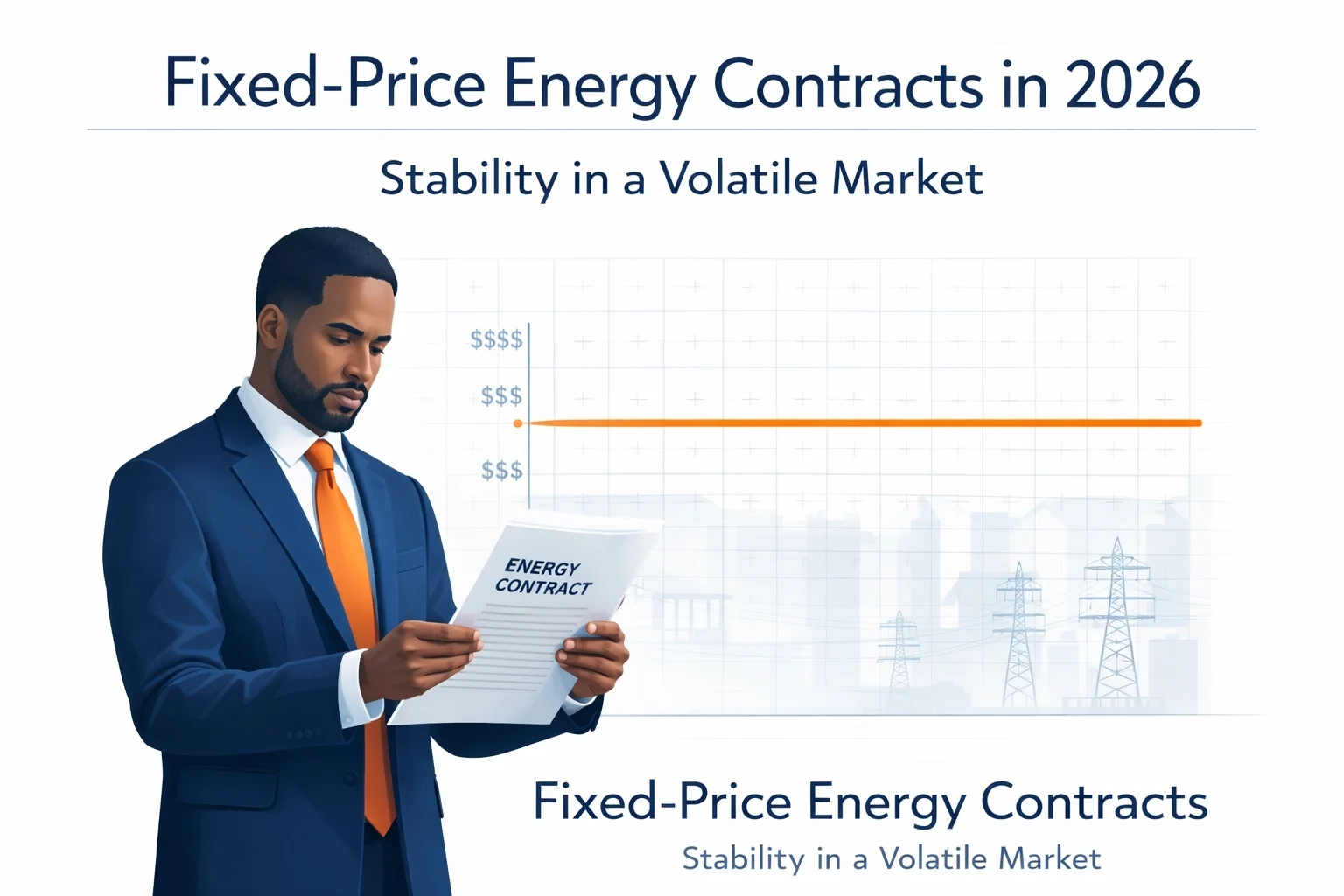
The U.S. energy landscape is changing fast, and it’s happening in ways that show up directly in wholesale pricing. The grid is balancing a growing mix of renewables and storage, while demand continues to rise in key regions due to factors like data center growth and electrification. The result is a market that is more dynamic and, in many cases, more volatile.
For most businesses, the best response isn’t trying to “out-trade” the market. It’s locking in budget certainty. A Fixed Pricing Contract is still one of the most effective ways to protect your operation from pricing swings and make energy costs predictable month to month.
Why the Grid’s Transition Increases Volatility (and Why Fixed Pricing Helps)
Here’s what’s driving the shift: the grid is integrating more variable generation, expanding storage, and responding to new large-load demand (especially data centers). That combination changes when power is abundant, when it’s tight, and how pricing behaves in wholesale markets.

From a business standpoint, the important takeaway is simple:
More complexity in grid operations typically leads to more frequent price swings
Those swings can flow into your supply costs depending on your contract structure
A Fixed Pricing Contract converts that uncertainty into a predictable budget line item
A fixed price isn’t about guessing the absolute bottom of the market. It’s about operational stability—especially for energy-sensitive businesses that don’t want a surprise on the P&L.
Major 2026 Factors Reshaping the Grid
Several major forces are moving at once, and they directly impact regional energy markets and pricing:
Renewables + Storage Integration: As more generation and storage are added, grid operators manage steeper ramp periods and tighter balancing requirements. That operational complexity can translate into more volatile wholesale intervals.
Transmission and Congestion Constraints: New supply and new demand do not always show up in the same place. Congestion and transmission limitations can cause sharp, location-specific price swings.
Data Center-Driven Demand: Hyperscalers are driving unprecedented demand for firm power in multiple regions. That demand growth increases competition for supply and can put upward pressure on energy and capacity components depending on the market.
What This Means for Your Restaurant, Manufacturing Plant, or Real Estate Portfolio
If you own or operate a business with significant energy consumption—restaurants with commercial kitchens, manufacturing facilities running 24/7, or multi-property real estate portfolios—this grid transition impacts you in three critical ways:
1. Wholesale Price Volatility
As the grid incorporates more variable generation, expands storage, and serves new large-load demand, wholesale pricing patterns are changing. You can see sharper moves during peak demand windows, during extreme weather, and in constrained zones where transmission can’t keep up.
What you can do: For most businesses, a Fixed Pricing Contract is the cleanest way to reduce exposure. It protects your budget from market spikes and makes forecasting easier. Index pricing can still make sense in specific cases, but it requires more risk tolerance and a plan to manage volatility.
2. Capacity Charges Are Climbing
Here's the part most business owners miss: While renewable energy itself is cheap, integrating it into the grid isn't. Capacity charges: the fees you pay to ensure the grid can meet peak demand: are climbing in many markets as utilities invest billions in transmission upgrades, battery storage, and grid modernization.
In PJM (covering 13 states including Pennsylvania, New Jersey, and Illinois), capacity prices have spiked significantly. In ISO-New England, capacity costs are a growing portion of your total bill. These charges show up as separate line items on your utility bill, and many businesses don't realize they're negotiable depending on your contract structure.
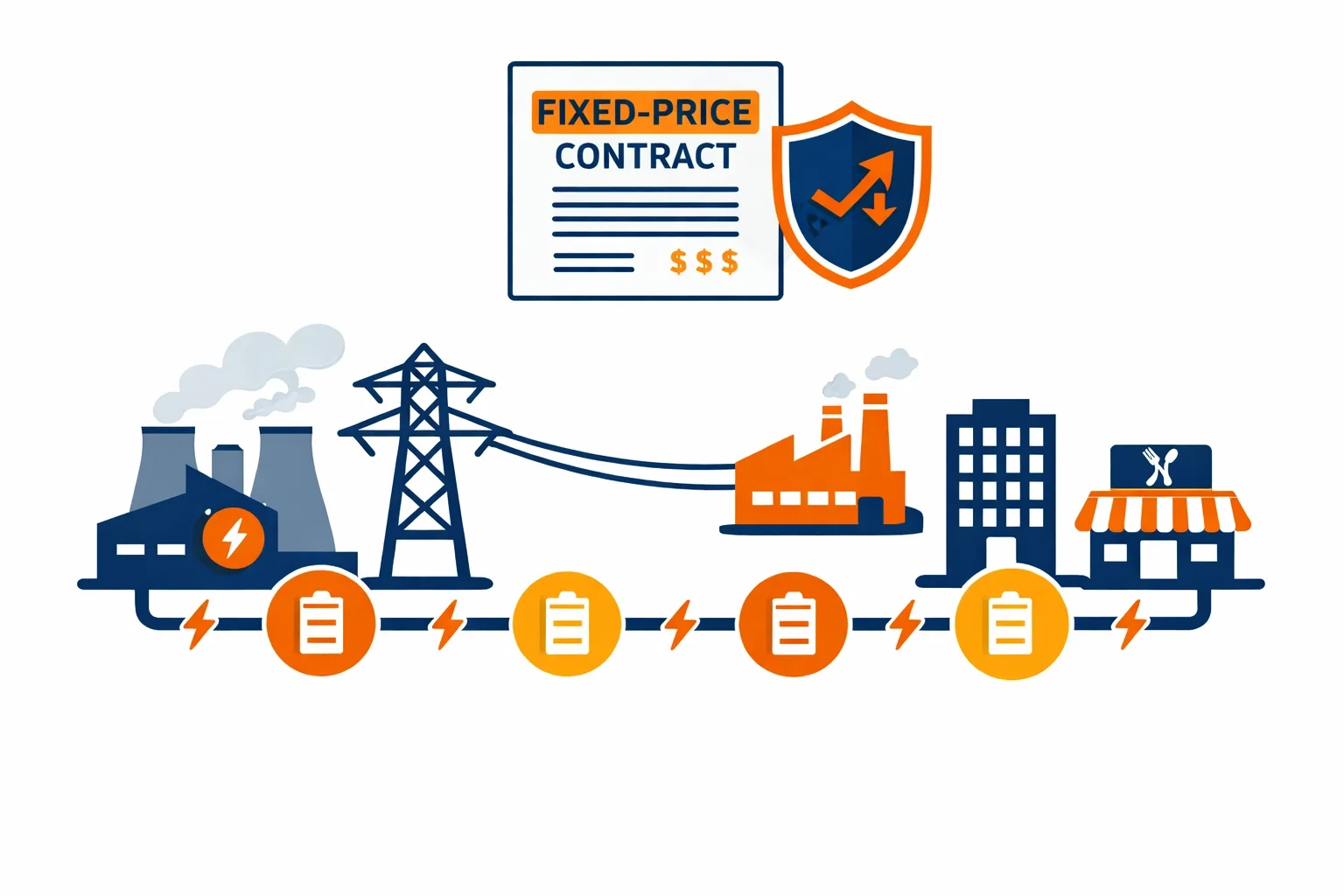
What you can do: Work with an independent energy consultant who understands capacity market mechanics. The right contract structure can minimize your exposure to these costs, but you need expertise to navigate the options.
3. Grid Reliability Concerns
More renewable generation means more complexity. Solar and wind are weather-dependent, and despite rapid battery deployment, the grid still relies on natural gas peaker plants to meet demand when renewables aren't producing. This creates reliability concerns during extreme weather events: both winter cold snaps and summer heat waves.
For manufacturing operations that can't afford downtime, or restaurants with perishable inventory, understanding your supply risk is critical. Some markets offer interruptible rates (lower prices in exchange for curtailment rights), while others are implementing demand response programs that pay you to reduce consumption during peak events.
Policy and Market Uncertainty Add Another Layer of Complexity
Even beyond pure supply/demand fundamentals, regulatory changes, market rule updates, and state-by-state differences add uncertainty. That uncertainty affects:
how capacity and transmission costs are calculated and passed through
how utilities and suppliers structure risk premiums
how pricing behaves during high-stress system events
For multi-state operations, this complexity multiplies. Your New Jersey properties can face different market dynamics than your Pennsylvania locations, and your Texas facilities operate in a completely different regulatory environment.
How United Energy Consultants Helps You Navigate This Transition
This is where our 20+ years of experience makes a tangible difference. We've navigated multiple energy market cycles: from deregulation's early days through the shale gas boom, polar vortex price spikes, and now the renewable transition. Here's how we help:
Independent Expertise Without Supplier Bias
Unlike brokers tied to specific suppliers, we maintain relationships with over 80 energy suppliers across deregulated markets. This independence means we're negotiating on your behalf, not steering you toward whatever supplier pays us the highest commission. When renewable energy creates pricing opportunities or risks in your market, we identify them without bias.
Energy Tracker Pro: Data-Driven Decision Making
Our proprietary Energy Tracker Pro software gives you real-time visibility into your energy consumption patterns across all your locations. During this renewable transition, understanding when and how you use energy is critical. Are you consuming heavily during solar production hours (cheaper) or during evening peaks (expensive)? Energy Tracker Pro shows you the patterns so you can make informed decisions about contract timing and structure.

Market Timing and Contract Strategy
The changing grid is creating conditions that didn’t matter as much five years ago: sharper peaks, more frequent pricing swings, and more cost components that can move independently. We analyze your specific situation—industry, consumption pattern, risk tolerance, budget constraints—and match you with the right strategy. For many organizations, that strategy starts with a Fixed Pricing Contract to lock in stability.
Real-World Example: How Fixed Pricing Protects Your Bottom Line
Consider a mid-sized manufacturing client in New Jersey. They were coming up on renewal heading into a period of higher market uncertainty: tighter capacity conditions, more aggressive peak pricing, and broader volatility tied to weather and demand swings.
We negotiated a Fixed Pricing Contract that prioritized budget certainty and protected them from upside risk during peak events. The result was a cleaner cost structure they could forecast against—without changing their operational schedule.
That’s the difference between “hoping the market behaves” and putting a stability-first contract in place.
What You Should Do Now
The grid transition isn’t slowing down. With more renewables, more storage, and more large-load demand coming online, the grid you’re buying power from today can look different next year—and dramatically different in five years.
Here's your action plan:
Get a baseline understanding of your current energy costs, including capacity charges and transmission fees (not just the commodity rate)
Review your contract expiration dates across all locations: you want flexibility to capitalize on market changes
Understand your consumption patterns: when you use energy matters more now than it did when baseload coal dominated the grid
Talk to an independent energy expert who understands wholesale market volatility and how to structure Fixed Pricing Contracts for stability
Ready to Lock In Stability with Fixed Pricing?
The 2026 energy landscape rewards businesses that reduce exposure to volatility instead of leaving energy costs on autopilot. With the grid changing and wholesale pricing becoming more complex, a Fixed Pricing Contract is often the most practical way to protect your budget and keep operations predictable.
Get a free bill analysis from United Energy Consultants. We’ll show you where you’re overpaying, what your contract options really look like, and how to structure fixed pricing that fits your business.
Visit uecnow.com or reach out directly. With 20+ years navigating energy market changes, complete independence (no supplier affiliations), and our proprietary Energy Tracker Pro utility management platform, we’ll help you lock in stability while the market does what it does.
The grid is changing. A fixed price helps your business stay steady anyway.