
The Fall 2026 Energy Buying Playbook: How NJ Real Estate Owners and Businesses Can Lock In Rates Before Winter Hits

For commercial energy buyers, September through November is the critical fall shoulder buying window. Summer peaks have passed, winter demand has not yet returned, and businesses still have time to evaluate supply contracts before cold-weather volatility and capacity risk premiums become more prominent.
The timing is especially important in New Jersey and other deregulated states connected to PJM. Capacity prices have cleared at $329.17 per megawatt-day for the 2026/27 delivery year and $333.44 per megawatt-day for 2027/28. These costs are now a primary driver of commercial electricity pricing.
At the same time, most suppliers are offering contracts with some form of capacity, regulatory, or market pass-through clause. The result is a market where the lowest advertised cents-per-kilowatt-hour rate does not necessarily represent the lowest total cost.
1. Why Capacity Is the Main Energy Cost Risk for 2026–2028
PJM’s capacity market compensates generation and demand-response resources for maintaining availability during periods of system stress. Suppliers recover those costs through customer supply rates, capacity adders, or pass-through charges.
The recent price trajectory demonstrates the scale of the change:
2024/25: $28.92/MW-day
2025/26: $269.92/MW-day
2026/27: $329.17/MW-day
2027/28: $333.44/MW-day
The 2026/27 price represents approximately $120,147 per MW-year, while the 2027/28 price represents approximately $121,706 per MW-year, before supplier margins and other delivery components.
For a facility with a 1 MW capacity obligation, the capacity component alone can therefore exceed $120,000 annually under these delivery-year prices. A property portfolio, manufacturing operation, hotel, or data center with several megawatts of peak exposure can face a materially larger obligation.
The New Jersey Board of Public Utilities’ August 2026 PJM capacity market report identifies capacity prices as a major contributor to rising electricity costs. The report also notes that PJM’s forecasted summer peak demand increases from approximately 156 gigawatts in 2026 to 183 gigawatts in 2030, with data center growth representing a substantial share of the projected increase.
The market summary is clear: capacity risk is no longer a secondary line item. It is a central contract decision.
2. Why Fall Is the Strategic Buying Window
Fall sits between two periods of elevated operational risk:
Summer cooling demand and PJM peak exposure
Winter heating demand, fuel constraints, and weather-related volatility
During September, October, and November, many businesses have more time to review usage data, analyze contract language, and compare supplier offers before winter conditions influence forward pricing.
The fall buying window provides an opportunity to:
Review the current contract before renewal pressure begins
Compare fixed, indexed, and hybrid supply structures
Evaluate capacity pricing for upcoming delivery years
Request supplier pricing before winter risk premiums increase
Align contract terms with the facility’s budget and operating profile
This is particularly relevant for customers with contracts expiring in late 2026, early 2027, or mid-2027. Waiting until the winter buying period can leave less time to negotiate and may expose the business to a wider range of supplier risk premiums.
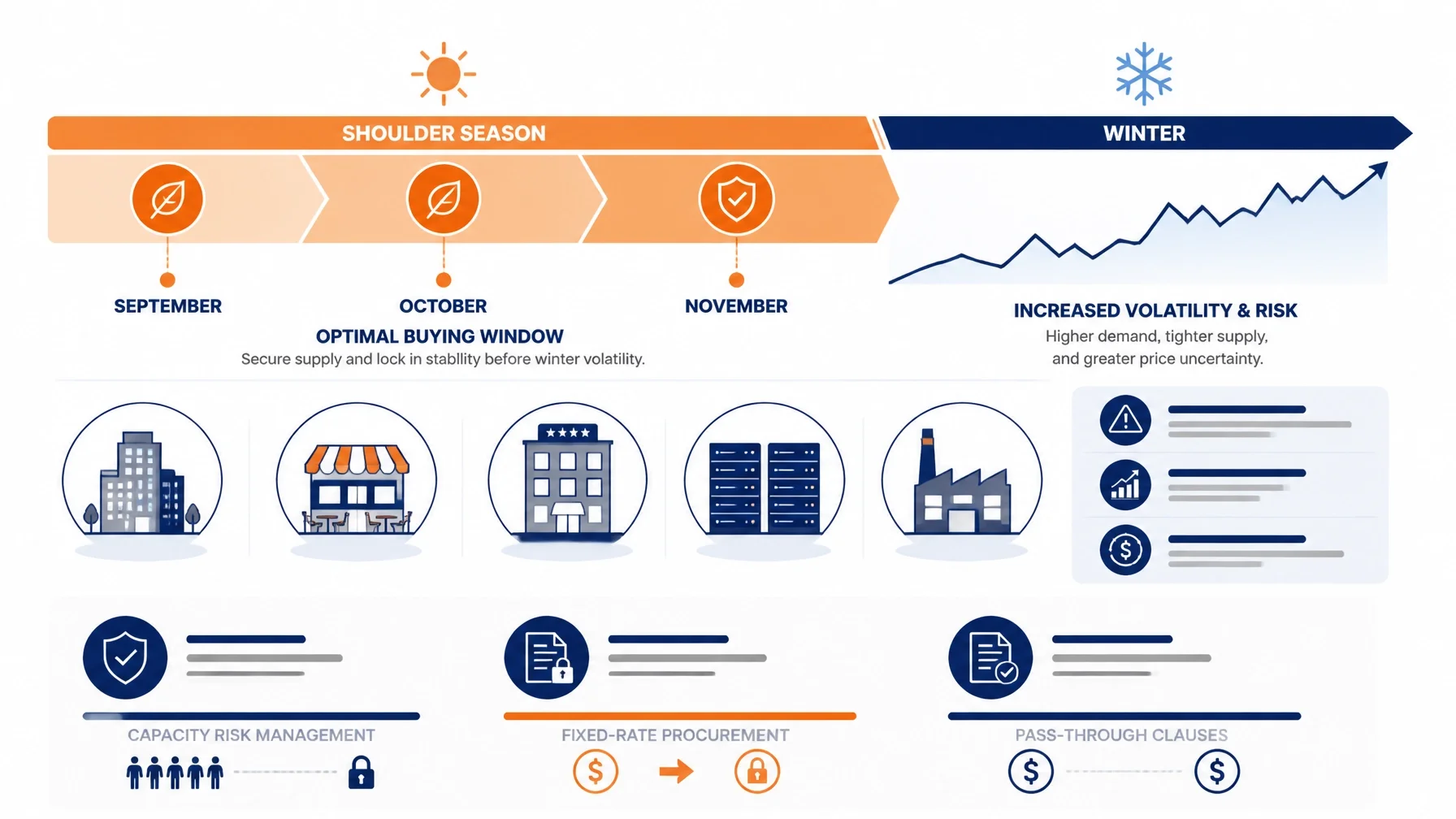
Fall does not eliminate market risk. It creates a more controlled period for managing it. The objective is not simply to secure a fixed price; it is to secure a contract structure that clearly defines who bears capacity, transmission, regulatory, and market-change risk.
3. Pass-Through Clauses Make Contract Language More Important
A fixed energy rate is not always a fixed all-in rate.
Many commercial energy contracts now separate the commodity portion from other charges. A supplier may offer a fixed cents-per-kilowatt-hour rate while retaining the right to pass through changes related to:
PJM capacity
Transmission
Ancillary services
Renewable portfolio standards
Public policy requirements
Regional uplift charges
Regulatory changes
Changes to PJM market rules
Utility-specific adjustments
Common contract terms include capacity adjustment, regulatory change, market structure change, RPM pass-through, and non-bypassable charges.
Before accepting a proposal, the contract should answer several specific questions:
Is the capacity component fixed for the entire term?
Is capacity billed using the customer’s actual PLC or an estimated assumption?
Can the supplier adjust the rate after a PJM auction?
Are capacity changes passed through at cost or with an additional adder?
Does the supplier have the right to reprice after a regulatory change?
Are transmission and ancillary service charges included or excluded?
What happens when the contract expires?
Does the rate apply to every meter and location in the portfolio?
The New Jersey BPU’s February 12, 2026 electricity auction announcement confirms that capacity and wholesale energy costs are important components of commercial supply pricing. The announcement also explains that large commercial and industrial customers may be served through competitive third-party contracts rather than the utility’s default supply structure.
In the current market, the clause controlling cost allocation can be as important as the headline rate.
4. Build a Buying Strategy Around the Business’s Load Profile
Different businesses experience capacity risk differently. A procurement strategy should reflect how and when the facility consumes power.
Commercial real estate
Office buildings, retail centers, and mixed-use properties may create high demand through simultaneous HVAC, lighting, elevators, ventilation, and tenant loads. Property owners should review each meter separately and identify whether tenant turnover or building improvements are changing the load profile.
Restaurants
Restaurants combine refrigeration, cooking equipment, ventilation, lighting, and air conditioning. Kitchen operations can create substantial coincident demand during the same afternoon hours when the grid is under stress.
Hotels
Hotels operate around the clock. Guest-room HVAC, laundry, kitchens, elevators, common-area lighting, and domestic hot water can produce a high baseline load. Hotel operators should compare current usage against occupancy, room count, seasonal demand, and equipment schedules.
Data centers
Data centers maintain a relatively consistent load but face significant cooling requirements and expansion risk. Contract flexibility, capacity treatment, uptime requirements, and future load additions are key considerations.
Manufacturing
Manufacturing facilities may carry large motor loads, process equipment, compressed air systems, refrigeration, and production cooling. Shifting noncritical processes away from peak periods can support future PLC management, although it does not immediately change an already-established tag.
Across these sectors, the buying process should use at least 12 months of billing history, with 24 months preferred where available. The analysis should include:
Monthly kWh consumption
Peak kW demand
Current PLC or capacity tag
Contract expiration date
Seasonal load changes
Facility operating hours
Planned expansions or closures
Equipment replacements
Historical capacity charges
Meter-specific usage patterns
5. Choose the Right Contract Structure for the Risk
The main commercial supply structures have different consequences in the 2026 market.
Fully fixed all-in pricing
A fully fixed contract can provide budget certainty when capacity and other defined components are included without discretionary adjustment clauses.
Advantages:
More predictable monthly budgeting
Reduced exposure to winter market volatility
Easier forecasting for leases, production, and operating expenses
Risks:
The supplier may include a significant risk premium
The contract may still exclude regulatory or capacity changes
The customer may not benefit if market prices decline
Fixed energy with capacity pass-through
This structure fixes the commodity component while passing capacity through at actual cost or through a defined formula.
Advantages:
Potentially lower starting commodity rate
Greater transparency if the formula is clear
Flexibility for sophisticated energy buyers
Risks:
Direct exposure to high PJM capacity prices
Budget uncertainty
Possible adders or true-ups
Increased sensitivity to future market reforms
Hybrid procurement
A hybrid structure can fix a portion of expected usage while leaving another portion indexed. It may also fix capacity while allowing the energy component to float.
Advantages:
Balances cost certainty and market flexibility
Can match different facilities within a portfolio
Allows staged procurement instead of a single market decision
Risks:
More complex contract administration
Requires accurate load modeling
Poorly defined formulas can create unexpected costs
The correct choice depends on the business’s cash-flow requirements, operating flexibility, credit position, expansion plans, and tolerance for market volatility.
6. Use Utility Data to Manage More Than the Supply Rate
Energy procurement does not end when a contract is signed. Bill accuracy, usage changes, and capacity exposure require ongoing monitoring.
United Energy Consultants’ proprietary Energy Tracker Pro software helps businesses organize utility information, monitor consumption, identify billing anomalies, and evaluate performance across multiple locations.
For a real estate owner or multi-site operator, this can help connect:
Utility charges to individual properties
Energy consumption to occupancy
Demand spikes to equipment schedules
Contract pricing to actual usage
Capacity costs to facility peak exposure
Budget variances to operational changes

A supplier proposal based on inaccurate usage assumptions can produce an apparently competitive rate that performs poorly after implementation. Data makes it possible to compare offers using the same load assumptions and to identify whether projected savings are caused by the rate, reduced usage, lower capacity exposure, or a contract accounting difference.
7. Why Independent Procurement Matters in Fall 2026
Supplier-affiliated brokers may have commercial relationships that influence which offers are presented. United Energy Consultants operates independently, with no supplier affiliations, so the procurement process is structured around the customer’s requirements.
The company provides:
Competitive supplier negotiations
Custom buying strategies based on usage data
Contract and pass-through clause review
Capacity and PLC analysis
Utility bill and usage monitoring
Energy Tracker Pro access
Ongoing account management
United Energy Consultants has more than 20 years of energy-market experience, maintains strong wholesale relationships, and serves businesses across deregulated states. Services are provided with zero out-of-pocket costs to clients.
For additional context, business owners can review United Energy Consultants’ analysis of commercial electricity rate comparisons and NJ capacity cost exposure.
Fall 2026 Energy Buying Checklist
Before winter demand returns, businesses should:
Confirm the current contract expiration date
Obtain the latest 12 to 24 months of utility bills
Identify the current PLC and capacity treatment
Request fixed and pass-through pricing options
Compare 12-, 24-, and 36-month terms
Review regulatory and capacity adjustment clauses
Model the offer against actual usage
Account for planned expansions or operating changes
Compare multiple suppliers on an all-in basis
Establish a billing and usage monitoring process
The combination of $329.17/MW-day capacity pricing for 2026/27, $333.44/MW-day for 2027/28, and widespread pass-through language makes fall procurement a time-sensitive budgeting decision.
Now is the time to review the contract, quantify capacity exposure, and secure a buying strategy before winter volatility adds another layer of risk. Contact United Energy Consultants for an independent, no-cost review of your business’s energy supply options.
Sources:
New Jersey Board of Public Utilities : An Investigation of PJM’s Capacity Market, August 2026
NJBPU : New Jersey Releases New Report Outlining Strategic PJM Market Reforms, August 13, 2026
United Energy Consultants : How to Choose the Best Electricity Rates for Your Commercial Business
United Energy Consultants : The Silent Surge: How NJ’s Capacity Rate Hike Is Hitting Energy Bills