
Winter 2026-27 Energy Forecast for Businesses: The Two-Track Market and How to Lock In Before Demand Season

Natural gas prices are forecast to average about $3.16/MMBtu in 2027, and storage is expected to enter winter slightly above its five-year average. Yet power market prices and capacity costs tell a more cautious story. For businesses in New Jersey and other deregulated markets, that split creates a two-track winter: relatively stable commodity fundamentals alongside rising electricity-system and capacity risks.
That distinction matters when you choose when and how to renew. Waiting for gas prices to fall further may not reduce the electricity price your business is offered if capacity costs, demand, and grid scarcity are driving the quote.
1. Two tracks, two different cost signals
The U.S. Energy Information Administration’s October 2026 Winter Fuels Outlook forecasts mixed household heating costs for the 2026–27 winter. Electricity expenditures are expected to rise about 4%, while natural gas expenditures are forecast to fall 9% and propane expenditures 3%. Heating oil moves in the opposite direction: spending is projected to rise 21%, with prices about 34% higher than last winter.
The regional outlook is also uneven. EIA forecasts a warmer winter in the Northeast than last year, but much colder conditions in the West. These are household expenditure projections, not forecasts for commercial supply rates. They do, however, illustrate why fuel type and location shape the seasonal outlook.
For natural gas, the October EIA Short-Term Energy Outlook forecasts an average Henry Hub price of approximately $3.16/MMBtu in 2027. Storage is forecast to be modestly above the five-year average, supporting a relatively well-supplied commodity outlook.
That is the first track: gas fundamentals look comparatively contained. The second track is electricity-system exposure.

2. Power and capacity risk remain elevated
In PJM, summer power prices rose sharply year over year. October market updates describe an increase of about 56% across the summer period. The measure and comparison period matter: PJM’s official July market report shows load-weighted average locational marginal prices (LMPs) of $102/MWh in July 2026, compared with $59/MWh in July 2025. An increase of roughly 73% for that monthly series.
The market’s physical stress was also evident during July’s heat. PJM recorded a peak load of about 163 GW, while operating reserves reportedly fell to approximately 5 GW at the most constrained point. This points to a risk increasingly shaped not just by fuel prices, but by the balance between demand, available resources, and grid conditions.
Capacity costs add another layer. PJM’s 2026/27 capacity auction cleared at $329.17/MW-day, compared with $269.92/MW-day in 2025/26. The auction price is not the same as an hourly energy price; it reflects the cost of maintaining capacity to support system reliability. For businesses, it can still materially affect the price of a supply contract.
The Federal Energy Regulatory Commission’s September 29, 2026 decision to suspend PJM’s proposed Reliability Backstop Procurement for five months, until February 28, 2027, does not undo capacity prices already established for current delivery years. It delays a future procurement mechanism while further proceedings address its design.
Other regional markets are moving too, though not identically. October market updates describe increases in ISO New England and NYISO, but the size varies by market, location, and price measure. As of October 13, full-month October comparisons are not yet available.

3. Why lower gas prices do not guarantee lower power offers
Natural gas is an important fuel for electricity generation, but it is only one part of a commercial power price. A supplier’s offer also reflects the delivery period, market location, capacity obligations, expected load shape, and the cost of managing uncertainty.
That means a business can see stable gas forecasts while facing a higher electricity renewal quote. In PJM, capacity costs and periods of tight supply can influence pricing even when the underlying fuel outlook is relatively calm.
This is why waiting for a lower commodity benchmark can be a trap. If the price of capacity, transmission constraints, or scarcity exposure rises while a business waits, the total offer may not improve. And if a contract expires before a new strategy is in place, the business may have fewer options and less time to compare proposals.
The useful question is not simply “Will gas get cheaper?” It is “What is driving the specific price and risk in this contract, for this location, and this delivery term?”
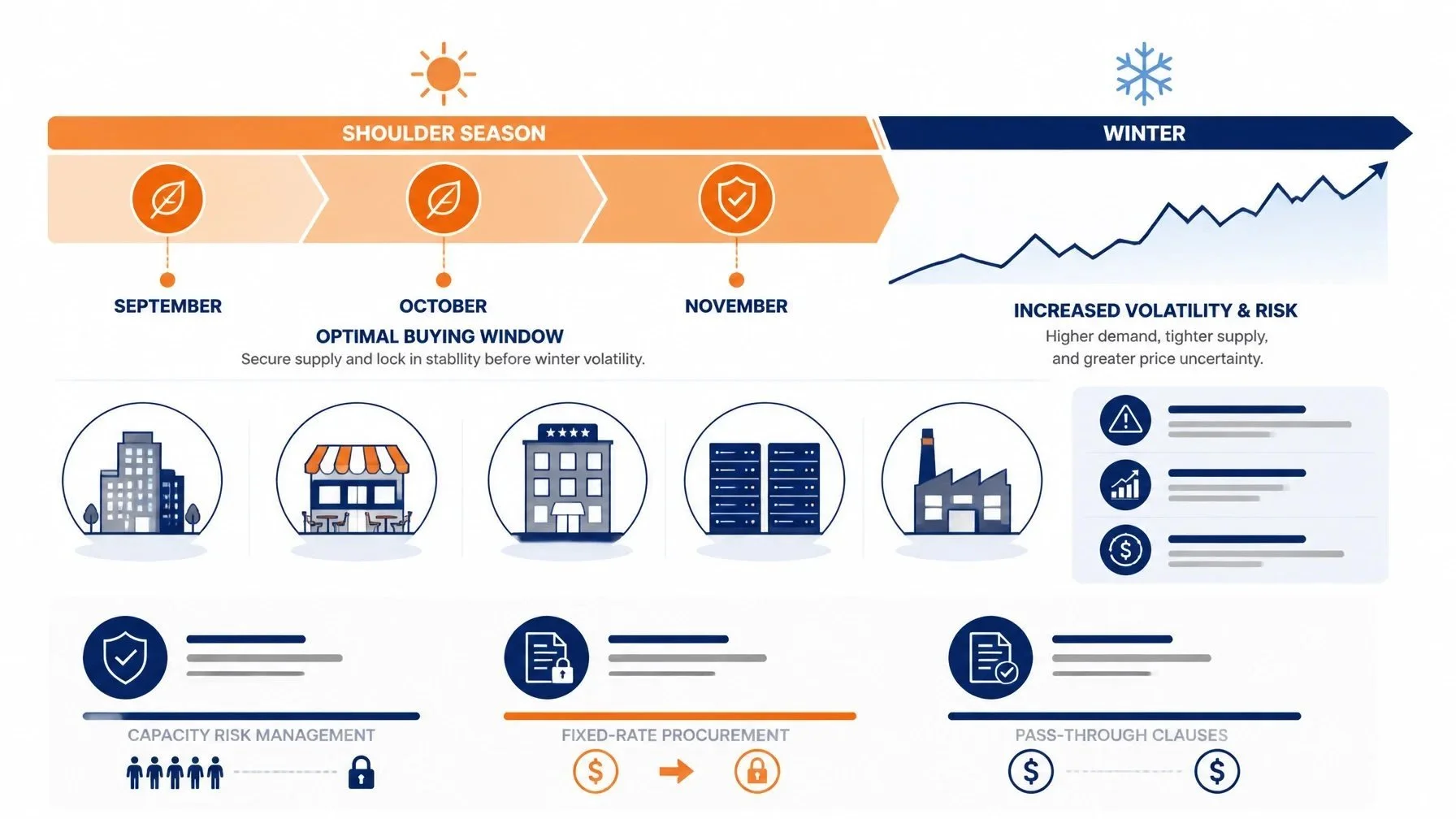
4. Use the shoulder season to prepare a renewal strategy
Fall offers businesses time to review contracts and compare options before winter demand intensifies. It does not guarantee a lower market price. It does provide an opportunity to make a decision based on actual usage rather than urgency.
Start by assembling the information suppliers need to price your account accurately:
Contract dates: expiration, renewal window, and any notice deadlines.
Usage history: ideally 12 to 24 months of bills and interval data.
Load profile: monthly kWh, peak kW, operating hours, and seasonal variation.
Capacity exposure: the account’s applicable capacity obligation and how it is reflected in offers.
Business changes: planned expansions, reduced operations, tenant changes, or equipment upgrades.
Then compare proposals on consistent assumptions. A lower advertised energy rate does not necessarily mean a lower total cost if the offer is based on a different usage estimate or treats cost components differently. Review the complete pricing structure and confirm what is included, what may change, and how the contract handles the business’s expected load.
5. Match procurement to your operations, not just the market headline
A hotel, office portfolio, manufacturing facility, and data center can have very different load profiles. A fixed-price structure may suit a business that prioritizes budget stability, while a staged or hybrid approach may be worth evaluating when consumption varies or future load is uncertain. The right fit depends on operating flexibility, financial priorities, contract timing, and tolerance for price movement.
For a multi-site business, review each facility and utility territory individually before deciding whether to procure them together. Differences in usage, market location, and contract dates can affect both available offers and the risk profile.
Ongoing monitoring also matters once a contract is in place. Energy Tracker Pro, United Energy Consultants’ utility management software, helps businesses track usage and review utility information across accounts. Better visibility can help identify changes in consumption and compare actual performance against the assumptions used in a procurement decision. Learn more about Energy Tracker Pro.
6. Turn the forecast into an actionable plan
The winter outlook is not a promise that commercial energy rates will fall, or rise, by a specific amount. It is a signal that commodity costs and power-system risks are moving on different tracks. Businesses that focus on gas alone may miss the capacity and scarcity factors shaping electricity offers.
Before winter demand season advances:
Confirm expiration dates and renewal deadlines for every account.
Gather bills and interval usage data, preferably covering 12–24 months.
Review capacity exposure and verify the assumptions behind supplier quotes.
Compare offers using the same load profile and contract term.
Decide whether budget certainty, flexibility, or a blended strategy best fits each facility.
Set a monitoring plan for usage and bills after renewal.
United Energy Consultants works across deregulated states, has more than 20 years of experience, and is completely independent, with no supplier affiliations. Services come with zero out-of-pocket costs to clients. The team uses your usage data to negotiate contracts and develop a buying strategy aligned with your business’s needs.
If your contract expires in the coming months, start reviewing your options now, not after winter demand is already shaping the market. Contact United Energy Consultants to assess your usage, compare available offers, and plan your next renewal.