How Companies Can Improve Energy Efficiency Without Major Investments
For most business owners and facility managers, the phrase "energy efficiency" triggers thoughts of expensive solar panel installations, high-tech geothermal systems, or replacing an entire fleet of industrial machinery. While these capital-intensive projects certainly have their place, they are not the only: or even the most effective: way to immediately impact your bottom line.
In the current economic landscape of 2026, where business energy costs remain volatile, the most successful companies are those that look inward at their operations before looking outward at new equipment. Research indicates that energy typically accounts for 20% to 30% of total operating costs in commercial buildings. This makes utility management one of the largest controllable expenses for restaurants, hotels, and manufacturing plants.
At United Energy Consultants, we have spent over 20 years proving that significant savings can be achieved through strategy, data, and behavioral shifts: all with zero out-of-pocket costs.
1. Operational Load Shifting: Mastering the Timing of Energy
One of the most misunderstood aspects of a commercial energy bill is the "Demand Charge." Unlike residential bills, which primarily charge for the total amount of energy consumed (kWh), commercial bills often include heavy fees based on the highest amount of power used at any single point during the billing cycle (kW).
Load shifting is the process of moving energy-intensive tasks to off-peak hours to flatten your demand curve.
Manufacturing: Instead of starting all heavy machinery simultaneously at 8:00 AM, stagger start times by 30 minutes. This prevents a massive "spike" in demand that sets your rate for the entire month.
Restaurants: High-heat equipment like dishwashers and ovens can be managed more strictly. A study of a restaurant chain showed a 17% energy reduction simply by ensuring equipment was turned off during prep periods and staggered during start-up.
Cold Storage: These facilities can "sub-cool" their environments during the night when electricity rates are lower and thermal mass can hold the temperature during the peak afternoon hours. You can read more about this in our guide on energy-saving strategies for cold storage facilities.
By shifting just 10% of your peak load to off-peak times, you can often see a double-digit reduction in your monthly utility statement without spending a dime on new hardware.

2. The Power of Data: Visualizing Waste with Energy Tracker Pro
You cannot manage what you do not measure. Most businesses treat their utility bill like a tax: something to be paid and forgotten. However, that bill contains a narrative of your operational efficiency, or lack thereof.
This is where energy management software becomes a game-changer. At United Energy Consultants, we provide our clients with Energy Tracker Pro, a proprietary tool designed to identify waste and inefficient patterns in real-time.
Identifying "Vampire" Loads
Many facilities consume a surprising amount of energy when they are closed. Computers, POS systems, HVAC units running on "hold" settings, and kitchen displays can account for 10% to 15% of total usage during unoccupied hours. Energy Tracker Pro identifies these "vampire loads," allowing management to implement strict shutdown checklists.
Benchmarking and Anomalies
If one hotel in a franchise is consuming 20% more energy than a sister property of the same size, data helps you find out why. Is it a faulty sensor? A walk-in freezer door with a bad seal? Data provides the "smoke" that leads you to the "fire," allowing for targeted repairs rather than expensive, broad upgrades. For hospitality leaders, this is a core component of enhancing guest experience while cutting costs.
3. The Bedrock of Efficiency: A Well-Negotiated Energy Contract
Efficiency isn't just about how much energy you use; it’s about how much you pay for every unit of that energy. A business could have the most efficient lighting in the world, but if they are on a "Default Service" rate with their utility, they are likely overpaying by 15% to 25%.
In deregulated markets, the "Power of Choice" allows businesses to shop for supply rates. However, the fine print in these contracts can be treacherous. A "low rate" might be offset by hidden pass-through charges, bandwidth clauses, or high early termination fees.
A strategic, fixed-price contract provides:
Budget Stability: Protects against price spikes like the recent 27% jump in natural gas prices.
Operational Freedom: Allows you to plan long-term capital improvements because your utility overhead is a known variable.
Risk Mitigation: Avoiding the 7 energy contract mistakes that typically cost businesses thousands of dollars.
4. Maintenance: The "Unsexy" Path to 15% Savings
Preventative maintenance is the lowest-hanging fruit in energy efficiency. Because it doesn't involve "new" technology, it is often overlooked, yet the ROI is nearly instantaneous.
HVAC Optimization
HVAC systems account for nearly 40% of energy use in commercial buildings. Simple adjustments can yield massive results:
Filter Changes: Clogged filters force motors to work harder, increasing energy draw by 5% to 15%.
Sensor Calibration: Thermostats and CO2 sensors that are out of calibration can cause systems to run when they aren't needed or over-cool spaces.
Coil Cleaning: Dirty condenser coils hinder heat transfer, forcing the compressor to run longer cycles.
Lighting and Occupancy
While LED retrofits are popular, simply adjusting the controls on your existing lighting can save money. Ensure that occupancy sensors in restrooms, storage rooms, and breakrooms are set to "Auto-Off" with a reasonable timeout period. If your facility has large windows, "daylight harvesting": dimming lights when natural light is sufficient: can be implemented via simple settings adjustments in many modern lighting controllers.

5. The United Energy Consultants Model: Zero Out-of-Pocket, Maximum Impact
The biggest barrier to energy efficiency is often the budget. Finance departments are often hesitant to approve large expenditures for "maybe" savings.
United Energy Consultants operates on an independent, zero out-of-pocket cost model. We don't charge you a consulting fee to analyze your bills or find you a better contract. We are compensated by the suppliers in our network of over 80 providers. This aligns our interests with yours: we find the most efficient, cost-effective solutions because our reputation and 20+ years of experience depend on your success.
Our approach includes:
Comprehensive Bill Auditing: Finding historical errors and securing refunds.
Competitive Procurement: Forcing suppliers to bid against one another for your business.
Ongoing Management: We don't just sign a contract and disappear. We monitor your usage through Energy Tracker Pro to ensure your efficiency strategies are working.
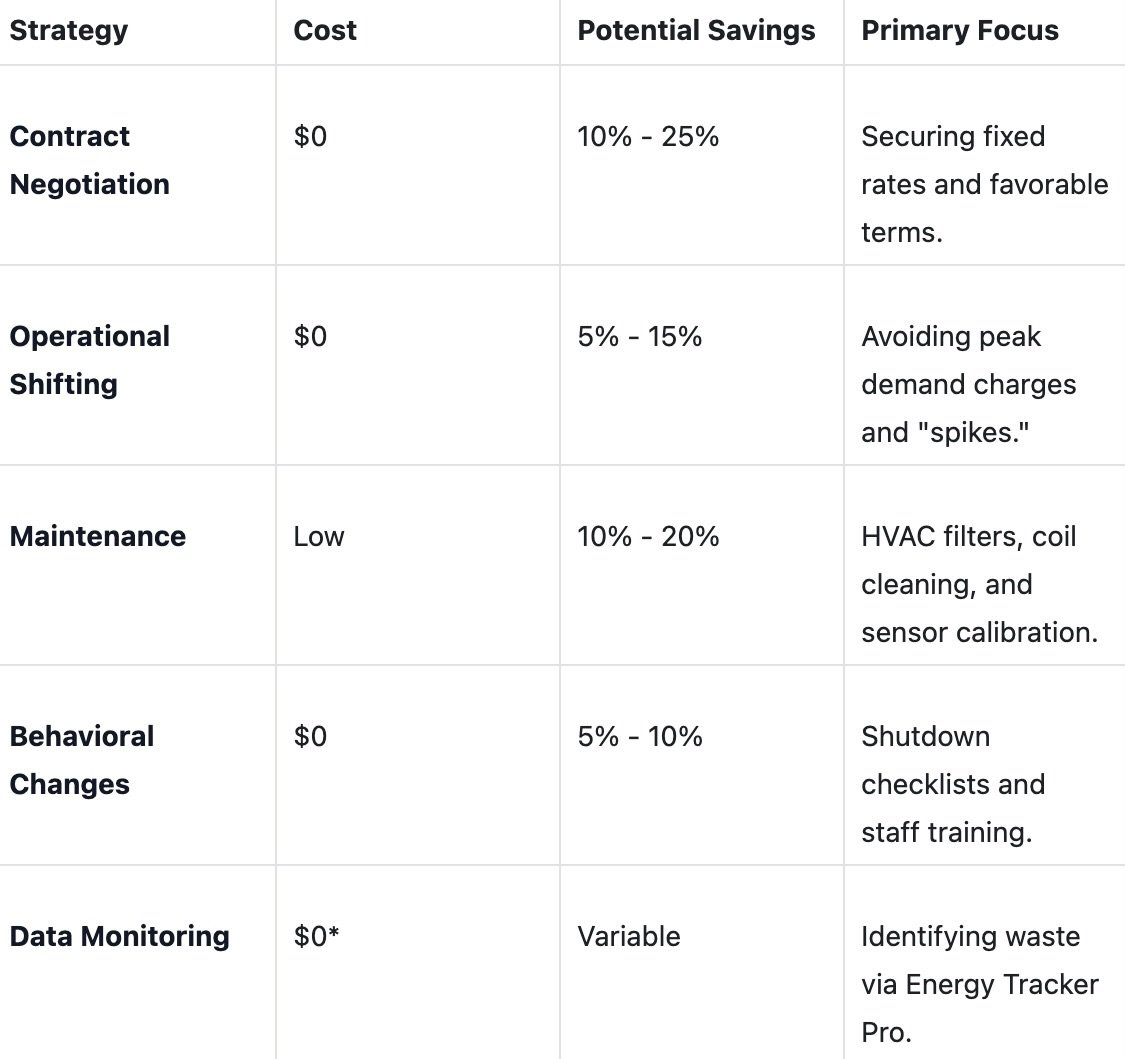
Summary of Actionable Steps
To reduce your business energy costs without a major investment, follow this hierarchy:
Conclusion
Improving energy efficiency doesn't require a million-dollar budget or a complete facility overhaul. By focusing on how you buy energy, how you time your usage, and how you maintain your existing assets, you can secure a competitive advantage in an increasingly expensive market.
Whether you are managing a single restaurant or a multi-state manufacturing operation, the principles of data-driven utility management remain the same. Start with the data, secure your contract, and refine your operations.
If you’re ready to see exactly where your energy dollars are going, learn more about the 5 ways we help businesses save big on utilities.