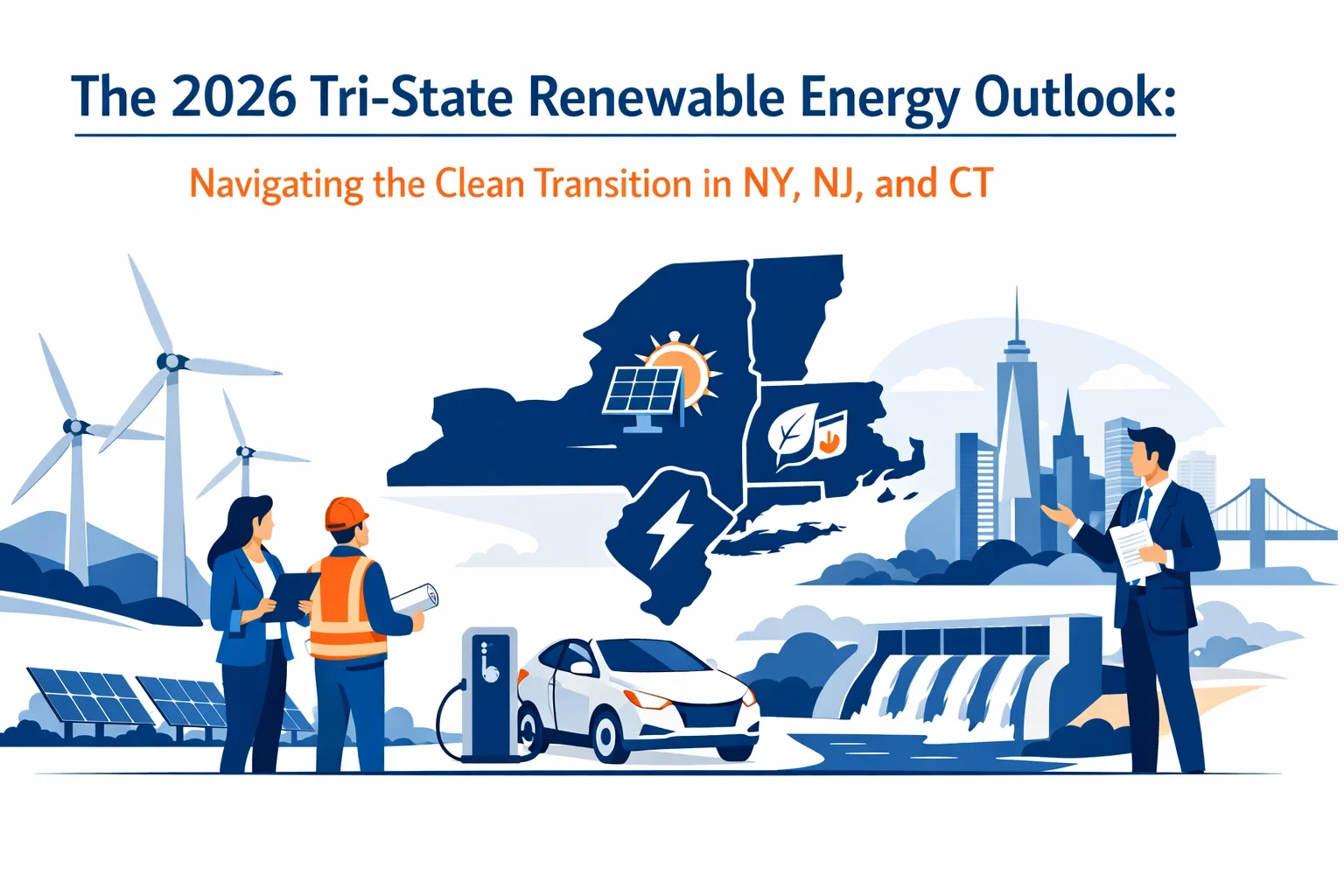
The 2026 Tri-State Renewable Energy Outlook: Navigating the Clean Transition in NY, NJ, and CT
As we move through the first quarter of 2026, the energy landscape across New York, New Jersey, and Connecticut is undergoing its most significant transformation in decades. For business owners and commercial property managers, the "energy transition" is no longer a boardroom concept: it is a daily operational reality.
The Tri-State area is currently a focal point for clean energy investment, but this shift comes with a complex set of challenges. While state mandates push for aggressive carbon reduction, the region is simultaneously grappling with aging infrastructure and shifting wholesale energy rates. Navigating this environment requires a sophisticated understanding of both the regulatory shifts and the emerging technologies that will define your business energy costs for the next decade.
The Offshore Wind Surge: Powering the Coastal Grid
The year 2026 marks a pivotal "delivery phase" for offshore wind in the Northeast. After years of planning and permitting, the physical manifestation of these projects is finally providing relief to a strained grid.
In New York, the focus is on meeting the Climate Leadership and Community Protection Act (CLCPA) mandate of 70% renewable energy by 2030. As of this March, South Fork Wind is fully operational, contributing 132 MW of clean power. However, the most anticipated milestone for 2026 is the progress of Empire Wind 1. Construction is moving rapidly, with expectations that it will begin delivering 810 MW directly into the New York City grid by the end of this year.
New Jersey is matching this ambition with its own offshore projects. The state is leveraging its coastal geography to become a hub for wind turbine manufacturing and deployment. These projects are critical because the region is facing a reliability crunch. With several aging "peaker" plants scheduled for retirement this year, the influx of wind energy is essential to prevent localized blackouts during peak summer demand.
For businesses, this influx of renewable supply is a double-edged sword. While it increases the availability of green power, the massive capital expenditure required for these projects often places upward pressure on electricity rates through delivery charges and system benefit fees. Understanding how these costs are structured in your energy contracts is more important now than ever.

New Jersey’s Solar Dominance and the Rise of Storage
While wind dominates the headlines, solar energy and battery storage are the "boots on the ground" for renewable growth, particularly in New Jersey. In 2026, the Successor Solar Incentive Program (SuSI) has matured, providing a stable framework for commercial property owners to monetize their roof space.
Community Solar Expansion
New Jersey’s community solar program has become a national model. It allows businesses that cannot install panels on their own sites: such as those in leased spaces or with shaded roofs: to subscribe to a local solar farm. This provides a direct path to reduce energy costs without any capital investment.
The Storage Mandate
Energy storage is the missing piece of the puzzle that is finally fitting into place in 2026. The state has incentivized large-scale battery storage projects to "smooth out" the intermittent nature of solar and wind. For commercial users, this means:
Peak Shaving: Using stored energy during high-cost periods to lower demand charges.
Grid Resilience: Enhanced protection against outages caused by an increasingly volatile climate.
Market Participation: Opportunities to earn revenue by discharging power back to the grid during high-demand events.
If you are operating a facility with high peak demand, such as a cold storage plant, exploring storage-backed contracts is a key component of modern utility management. You can learn more about specific strategies for these sectors in our guide on energy-saving strategies for cold storage facilities.
Regulatory Shifts and the 2026 Reliability Challenge
The regulatory environment in deregulated energy states like NY, NJ, and CT is currently in a state of high flux. In early 2026, the Tri-State Generation and Transmission Association approved a 7.5% wholesale electric rate increase. This increase reflects the heavy cost of modernizing the generation fleet and maintaining transmission lines that were never designed for the bidirectional flow of renewable power.
In New York, the NYISO (New York Independent System Operator) has flagged 2026 as a year of "narrowing margins." As demand for electricity grows: fueled by the electrification of heating systems and the proliferation of AI data centers: the grid’s surplus capacity is shrinking.
Key 2026 Regulatory Trends Include:
Capacity Charge Adjustments: Regulators are recalculating how capacity costs are distributed, often leading to higher bills for businesses that don't actively manage their peak load.
Carbon Pricing Integration: Continued discussions on how to bake the cost of carbon into wholesale market prices, which could fluctuate wholesale energy rates unpredictably.
Incentive Evolution: While federal tax credits have shifted, state-level "Clean Energy Standard" payments are becoming a more significant portion of the utility bill.
Navigating these changes requires a proactive approach to procurement. Relying on "default" utility service in 2026 is often the most expensive path for a business. Strategic energy buying strategies are necessary to hedge against this volatility.
Connecticut: Grid Modernization and Clean Tech Exploration
Connecticut is taking a distinct approach in 2026 by focusing heavily on grid modernization and the exploration of hydrogen technologies. The state’s Residential Renewable Energy Solutions (RRES) program saw a reduction in credits for excess energy starting this year, a move designed to encourage "behind-the-meter" consumption and storage rather than simple grid export.
For Connecticut businesses, the emphasis is on efficiency and "smart" infrastructure. The state is investing heavily in Advanced Metering Infrastructure (AMI), which provides real-time data to consumers. This data is the lifeblood of effective energy management software, allowing property managers to see exactly where waste is occurring.
Furthermore, Connecticut is exploring the potential of "Green Hydrogen" for industrial applications. While still in the early stages, 2026 has seen the launch of several pilot programs aimed at decarbonizing heavy industry that cannot easily switch to electric power.
The Business Impact: Risks and Opportunities
What does all of this mean for your bottom line? In 2026, the Tri-State energy market is characterized by volatility and opportunity.
The Risk of Inaction
Utility rates in New York and New Jersey are among the fastest-rising in the nation. For a commercial property manager, failing to lock in a strategic contract during this transition can lead to budget-busting spikes. As we noted in our recent analysis of natural gas price jumps, the interconnectedness of gas and electricity means that volatility in one market almost always bleeds into the other.
The Opportunity in Choice
The primary advantage for businesses in the Tri-State area is the power of choice. Because these are deregulated markets, you are not forced to accept the utility’s "Price to Compare." You can leverage competition among over 80 suppliers to find terms that fit your specific risk tolerance.
Whether it’s a fixed-price energy contract to ensure budget certainty or an index-based contract to take advantage of market dips, the right strategy can save a business thousands of dollars annually. For more details on why fixed pricing is particularly relevant this year, see our post on the 2026 energy shift.

Strategic Steps for 2026
To thrive in this environment, businesses should consider the following actions:
Audit Your Interval Data: Use granular data to understand your peak demand times and identify opportunities for demand response.
Review Existing Contracts: Many businesses are currently on contracts that do not account for the recent 7.5% wholesale increases. Ensure you aren't due for a "sticker shock" renewal.
Explore On-Site Solar/Storage: With the grid reliability concerns looming for Summer 2026, on-site assets offer a hedge against both high costs and potential outages.
Leverage Technology: Utilize energy management software to monitor usage in real-time and automate savings strategies.
Conclusion: A Resilient Path Forward
The 2026 renewable energy outlook for the Tri-State area is one of transition. We are moving away from a centralized, fossil-fuel-dependent grid toward a decentralized, cleaner, and more complex system. While the challenges of grid reliability and rising delivery costs are real, the tools available to businesses to manage these costs have never been more powerful.
By staying informed and proactive, commercial entities can not only weather the current market volatility but also position themselves as leaders in the sustainable economy. The transition to clean energy is an opportunity to take control of your energy future, lock in predictable costs, and contribute to a more resilient regional grid.
Partner with United Energy Consultants
At United Energy Consultants, we have spent over 20 years helping businesses navigate the complexities of the Tri-State energy markets. As an independent broker and consultant, we don’t work for the utility companies: we work for you.
Our team provides:
Independent Procurement: We leverage our relationships with over 80 vetted suppliers to find the most competitive wholesale energy rates for your business.
Energy Tracker Pro: Our proprietary energy management software gives you the data-driven insights needed to optimize your usage and reduce waste.
Strategic Consulting: From evaluating renewable energy credits to structuring complex energy contracts, we provide the expertise needed to navigate the 2026 market.
Don't let market volatility dictate your profit margins. Contact United Energy Consultants today to review your current energy strategy and discover how we can help you reduce costs and transition to a cleaner energy future.