

If you are a business owner in New Jersey, your June electricity bill likely arrived with a jarring realization: the cost of staying cool has reached an all-time high. On June 1, 2026, a significant commercial rate hike took effect across the state, resulting in a 17% to 20% increase in electricity costs for many businesses.
For office buildings, retail storefronts, warehouses, and real estate portfolios, this surge is not just a seasonal fluctuation, it is a fundamental shift in the cost of doing business. As temperatures climb and the grid faces its heaviest strain, the "default" utility rates are becoming a financial trap. However, because New Jersey is a deregulated energy state, you have the power to choose how you buy energy and how you use it.
This guide breaks down the data behind the hike, explains the critical "PLC Tag" season, and provides a blueprint for lowering your demand when it matters most.
The Data: Why Default Utility Rates are a Financial Trap
In the current 2026 market, many New Jersey businesses remain on "Basic Generation Service" (BGS), which is the default supply provided by the utility. Following the recent hikes, these default rates have spiked to approximately 19.9¢/kWh.
In contrast, businesses that leverage competitive procurement strategies are currently securing rates closer to 17.6¢/kWh. For a commercial property consuming 50,000 kWh per month, this 2.3-cent difference translates to over $1,150 in monthly savings, or nearly $14,000 annually.
Comparative Analysis of Supply Rates (June 2026):
Utility Default Rate (BGS): ~19.9¢/kWh
Competitive Market Rate: ~17.6¢/kWh
Percentage Difference: ~11.5% reduction in supply cost
Effective Date of Hike: June 1, 2026
By staying on the default rate, you are effectively paying a premium for the convenience of not choosing a supplier. In a year where energy costs have risen by 20%, that convenience is a luxury most businesses cannot afford.
Understanding "PLC Tag" Season (June–August)
While your supply rate is important, your "Capacity" and "Transmission" charges, which can make up 30-40% of your total bill, are determined by how much energy you use during specific peak hours in the summer. This is known as the Peak Load Contribution (PLC) Tag season.
Every summer, the regional grid (PJM) monitors the five highest usage hours across the entire network. Your business’s usage during those five specific hours will set your "PLC Tag" for the following year.
High Usage During Peaks: Results in a higher PLC Tag and higher fixed costs for the next 12 months.
Low Usage During Peaks: Locks in lower capacity charges, providing a "built-in" discount for the rest of the year.
Because these system peaks almost always occur on the hottest weekdays between June and August, your operational decisions right now will dictate your utility budget through 2027.

The 2 PM–6 PM Strategy: Mastering Load Shifting
The most effective way to protect your business from high PLC Tags and expensive "on-peak" energy is load shifting. Most grid peaks in New Jersey occur between 2:00 PM and 6:00 PM on humid, high-temperature days.
If you can reduce your demand during this four-hour window, you are not just saving cents on the dollar, you are lowering the foundation of your future energy costs.
How to Execute a Summer Load Shift
Pre-Cooling Spaces: Drop your HVAC setpoints by 2-3 degrees in the morning (e.g., from 8 AM to 12 PM). Once 2:00 PM hits, raise the setpoints to 74°F or 76°F. The "thermal mass" of your building will keep the space comfortable while the compressors remain largely idle during the peak.
Staggering Equipment: In warehouse or manufacturing environments, avoid running heavy machinery, air compressors, or industrial pumps simultaneously during the 2-6 PM window. If possible, schedule energy-intensive maintenance or production runs for the early morning or after 7:00 PM.
Lighting Adjustments: For retail and office spaces, utilize natural light where possible. Reducing overhead lighting by even 20% during peak hours reduces the heat load in the building, further decreasing the work your HVAC must do.
Real-Time Visibility with Energy Tracker Pro
The primary challenge for most real estate companies and business owners is that they don't know they are peaking until they see the bill 30 days later.
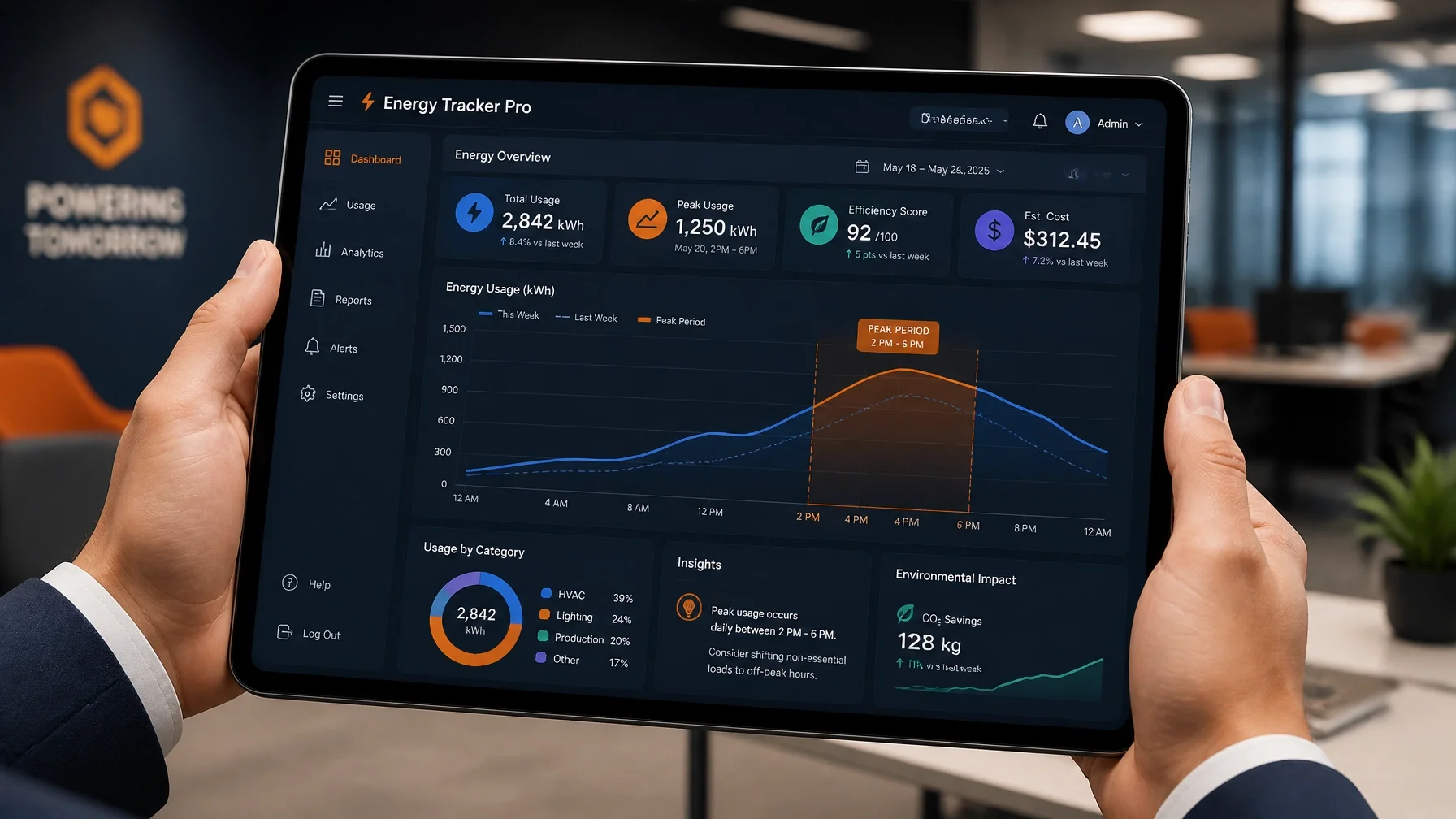
At United Energy Consultants, we provide our clients with Energy Tracker Pro, a proprietary software solution that offers real-time monitoring of your utility usage.
Predictive Peak Alerts: Receive notifications when a system peak is likely to occur, allowing you to trigger your load-shifting plan.
Usage Benchmarking: Compare your current performance against historical data to ensure your efficiency measures are actually working.
Automated Reporting: Eliminate the guesswork of tracking energy ROI across multiple properties or locations.
Deregulated Energy States: The Power of Choice
New Jersey is one of the few deregulated energy states where the "Energy Choice" program allows businesses to bypass utility monopolies. This deregulation creates a competitive environment where suppliers must bid for your business.
Strategic Energy Buying Strategies for 2026:
Fixed-Rate Contracts: Lock in a rate (like the 17.6¢/kWh mentioned above) to protect your business from the volatility of summer heatwaves.
Managed Portfolios: For larger organizations, a mix of fixed and index pricing can provide both stability and the ability to capitalize on market dips.
Zero Out-of-Pocket Consulting: Working with an independent consultant like United Energy Consultants ensures you are seeing the entire market, not just one supplier’s offer, with no upfront cost to your business.
Low-Cost Operational Wins for NJ Businesses
Beyond supply contracts and high-tech tracking, there are several immediate, low-cost steps any manager can take to reduce energy costs:
Seal the Envelope: Check for air leaks around loading docks in warehouses or entryways in retail spaces. A single gap can force an HVAC system to work 15% harder.
Server Room Optimization: Offices often over-cool server rooms. Research suggest most modern servers can operate safely at slightly higher temperatures than previously thought; increasing the temperature by even 2 degrees can yield significant savings.
Smart Thermostats: If you are still using manual thermostats, you are losing money. Smart, programmable thermostats ensure that energy isn't being wasted on an empty office at 9:00 PM.
Conclusion: Take Control of Your Summer Bill
The 17-20% rate hike that hit New Jersey on June 1st was a wake-up call. Between the high cost of default supply and the critical nature of PLC Tag season, "business as usual" is no longer a viable energy strategy.
By shifting your load during the 2 PM–6 PM window, leveraging competitive procurement to escape the 19.9¢ utility trap, and using tools like Energy Tracker Pro to monitor your demand, you can turn a summer of high rates into a summer of strategic savings.
Is your business overpaying for energy this summer?
Don't wait for your July bill to find out. Contact United Energy Consultants today for a comprehensive energy audit and a custom buying strategy designed to protect your bottom line.
FAQ: NJ Business Energy Costs
Q: Why did my rates go up on June 1st?
A: New Jersey utilities updated their commercial rates to account for increased infrastructure costs and higher wholesale energy prices. Many businesses saw a 17-20% increase in their default supply rate.
Q: What is a PLC Tag?
A: Your Peak Load Contribution (PLC) is a value assigned to your account based on your usage during the grid's peak hours in the summer. It determines your capacity charges for the following year.
Q: Can I really save money by changing suppliers?
A: Yes. Because NJ is a deregulated state, competitive suppliers often offer rates significantly lower than the utility's default BGS rate. Currently, the spread is approximately 2.3¢/kWh.