
The Data Center Boom is Jacking Up Your Energy Bill: 5 Strategies to Protect Your Business in 2026
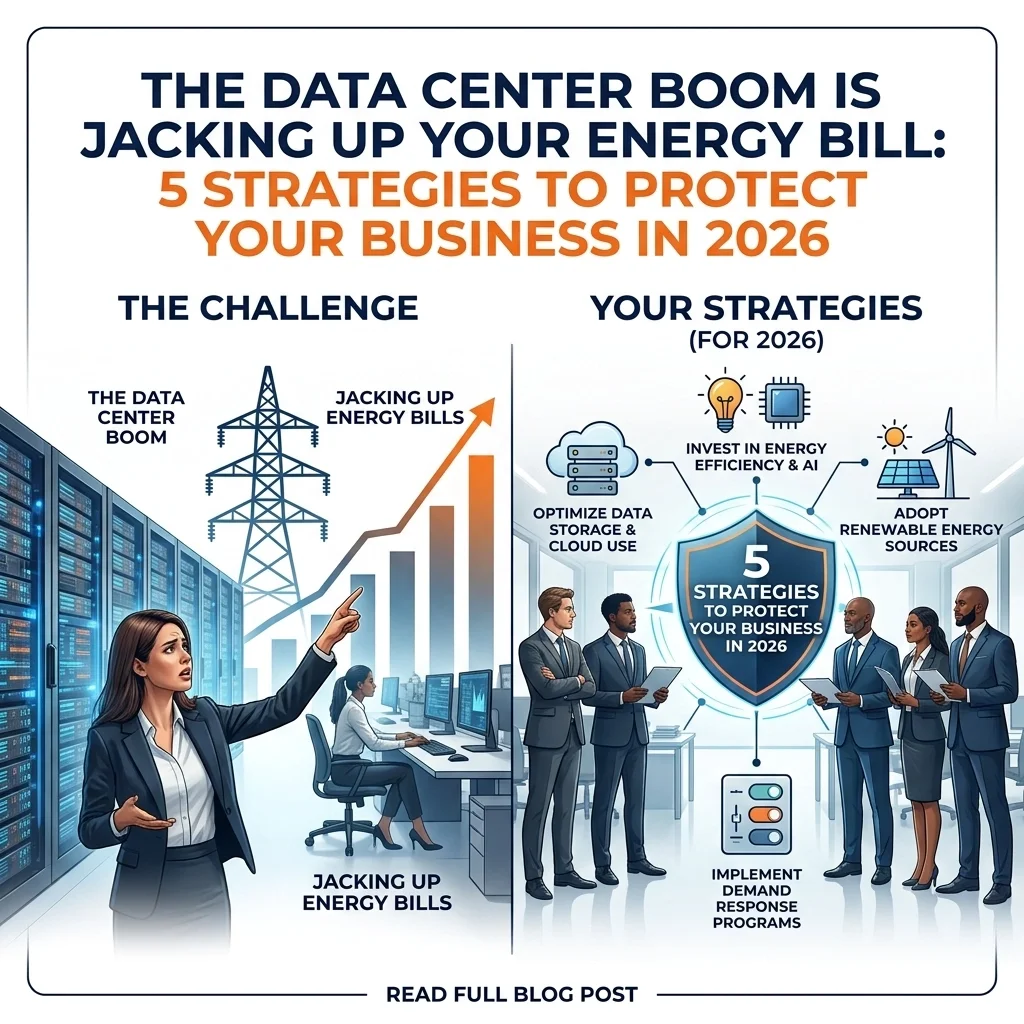
As we navigate through the first half of 2026, the energy landscape in the Tri-State area has reached a critical inflection point. For businesses across New Jersey, Pennsylvania, and New York, the monthly utility bill is no longer just a predictable line item: it has become a volatile variable that threatens bottom-line stability.
The primary culprit? An unprecedented surge in demand driven by the global data center and AI boom. While the "cloud" sounds ethereal, its physical manifestation consists of massive, power-hungry warehouses that are currently outstripping the grid’s ability to keep up. For the average non-tech business owner, this means the cost of "capacity": the fee you pay to ensure the grid can meet peak demand: is skyrocketing.
The Perfect Storm: PJM’s 833% Capacity Price Surge
The most alarming development for commercial energy consumers is the recent results from the PJM Interconnection capacity auctions. PJM, the regional transmission organization coordinating the movement of wholesale electricity in all or parts of 13 states (including NJ and PA), recently reported a staggering 833% increase in capacity prices for the 2026-2027 delivery year.
To put this in perspective, capacity prices that previously hovered around $28/MW-day have jumped to nearly $270/MW-day. This isn't a minor market fluctuation; it is a fundamental restructuring of energy costs.
Why Is This Happening?
The logic is simple but the impact is severe. We are facing a 6.6 GW capacity shortfall. As coal and older nuclear plants are retired, the replacement generation: largely renewables: is not coming online fast enough to offset the massive load added by new data centers. AI workloads require up to five times more power than traditional digital tasks, and the Tri-State area has become a primary hub for this infrastructure.
When supply drops and demand from high-priority tech giants surges, the local manufacturer, hotelier, or property manager is left holding the bill. If your business hasn't adjusted its procurement strategy yet, you are likely heading toward a "budget shock" that could compromise your 2026 and 2027 fiscal goals.

5 Actionable Strategies to Protect Your Business
At United Energy Consultants (UEC), we’ve spent over 20 years helping businesses navigate deregulated markets. We are seeing a "new normal" where passive energy management is no longer an option. Here are five strategies we are implementing for our clients right now to mitigate the impact of the data center boom.
1. Lock in Long-Term Fixed Rates Before the $333 Cap Hits
Market analysts are already looking toward the 2027/2028 delivery year, where the PJM capacity price cap is expected to hit $333/MW-day. This represents the maximum allowable price under current market rules: and we are on a collision course to reach it.
For many businesses, the "wait and see" approach is the most dangerous path. By securing a long-term fixed-rate contract now, you can insulate your business from the "Capacity Tag" volatility. Fixed-rate contracts offer budget certainty in an era where the market is anything but certain. If you are debating whether to wait for lower rates, our 2026 guide on locking in rates provides a deeper dive into market timing.
2. PLC (Peak Load Contribution) Management with Energy Tracker Pro
Your capacity charge is determined by your Peak Load Contribution (PLC), often referred to as your "Capacity Tag." This number is calculated based on your usage during the grid's highest demand hours of the previous year. If you use a lot of power during those critical "peaks," your bill will be higher for the entire next year.
At UEC, we provide our clients with Energy Tracker Pro, our proprietary software designed to monitor these trends in real-time. By identifying when these peak events are likely to occur, we can help you strategically reduce usage for just a few hours, potentially saving your business tens of thousands of dollars in capacity costs for the following year.
3. Turning Consumption into Revenue via Demand Response
If the grid is under stress, the grid operators are willing to pay you to stay off it. Demand Response (DR) programs allow businesses to receive payments for agreeing to reduce their electricity usage during periods of peak stress.
With the 6.6 GW shortfall, the grid needs load flexibility more than ever. Participating in DR doesn't just lower your own costs; it actually turns your facility into a virtual power plant. For a detailed breakdown of how to enroll and what the payouts look like in 2026, check out our Guide to Demand Response Programs.
4. Exploring Behind-the-Meter Generation or Co-Generation
As the "grid" becomes more expensive and less reliable due to data center congestion, many businesses are looking "behind the meter." On-site generation: such as natural gas micro-turbines (co-generation) or battery storage: allows you to bypass the traditional utility infrastructure during expensive peak times.
Data centers themselves are already moving toward this model, shifting from passive consumers to active grid stakeholders. Non-tech businesses in NJ and PA can adopt a similar approach. By generating even a portion of your own power, you reduce the "capacity" the utility needs to set aside for you, directly lowering your PLC.
5. Professional Energy Audits to Catch Billing Errors
With prices this high, a 5% error on a utility bill is no longer a minor nuisance; it’s a significant financial leak. Energy markets in the Tri-State area are complex, and utility billing systems are notoriously prone to errors in rate classes, tax exemptions, and meter readings.
A professional energy audit from UEC is a zero out-of-pocket process. We leverage our 20+ years of experience to scrutinize every line item of your history. In a high-cost environment, recouping past overcharges and ensuring your current rate class is optimized is the fastest way to find "hidden" capital.
The UEC Advantage: Why Your Choice of Partner Matters
The energy market in 2026 is a "zero-sum" game. The data centers have specialized teams working 24/7 to secure their power. Who is advocating for your business?
United Energy Consultants stands apart for several key reasons:
20+ Years of Experience: We have seen market cycles come and go. We understand the nuances of PJM and NYISO markets better than anyone.
True Independence: We have no ties to specific energy suppliers. This allows us to shop over 80 different suppliers to find the best rate for you, not the commission for us.
Energy Tracker Pro: Our data-driven approach removes the guesswork from PLC management and energy procurement.
Zero Out-of-Pocket Costs: Our interests are aligned with yours. We earn our keep by finding you savings and better terms.
Conclusion: Don't Let the AI Boom Drain Your Budget
The data center expansion isn't slowing down. With global electricity consumption for AI facilities projected to reach over 500 TWh this year, the pressure on the Tri-State grid will only intensify.
The 833% surge in capacity prices is a wake-up call for every business owner in NJ, PA, and NY. By taking proactive steps today: locking in rates, managing your PLC, and exploring demand response: you can ensure that your business remains competitive while others are blindsided by their utility bills.
Is your business ready for the 2027 $333/MW-day cap? Contact United Energy Consultants today for a comprehensive review of your energy strategy. Let us help you navigate the 2026 energy shift with the expertise your business deserves.