
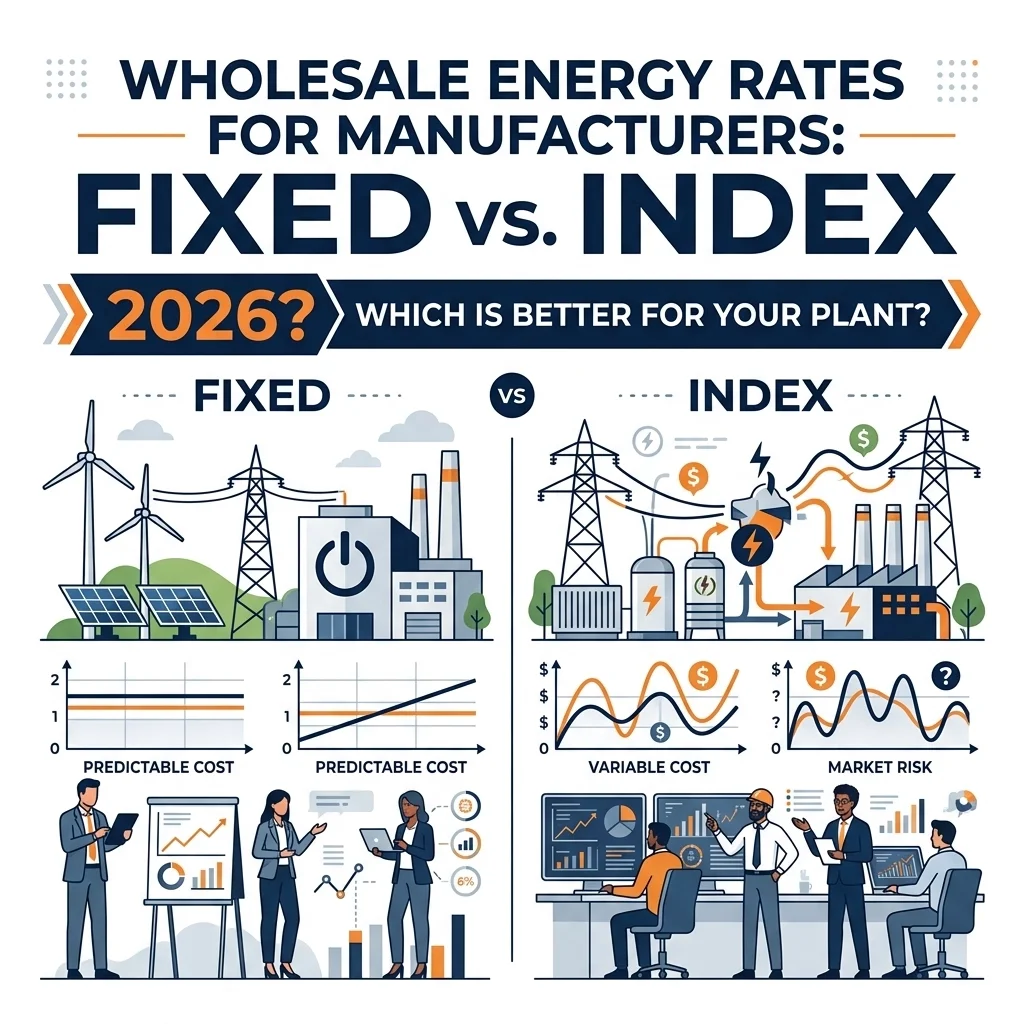
Wholesale Energy Rates for Manufacturers: Fixed vs. Index: Which Is Better For Your Plant in 2026?
If you’re running a manufacturing plant in the Tri-State area right now, I don’t need to tell you that the "quiet" days are over. We’ve hit May 2026, and the data coming across my desk at United Energy Consultants is, frankly, a bit alarming for anyone managing a bottom line.
The ISM Prices-Paid index, basically the thermometer for what manufacturers are paying for inputs: just hit a four-year high of 84.6. When that number climbs, it’s not just about the cost of raw steel or resin; it’s a direct reflection of the energy required to move, melt, and mold those materials. With global tensions pushing energy input costs to new heights, the "wait and see" approach isn't just risky: it’s expensive.
I’m Peter Kaplan, and I’ve spent the last 20 years helping businesses navigate these exact moments of volatility. The question I’m getting every day right now is: "Peter, should I lock in a fixed rate, or should I ride the index?"
There isn’t a one-size-fits-all answer, but there is a right answer for your specific plant. Let’s break down the 2026 landscape and see which strategy keeps your machines running without draining your bank account.
The Manufacturing Dilemma: High Stakes and Thin Margins
Manufacturing is energy-intensive by nature. Unlike a retail shop or an office building, a plant’s energy bill can be one of its top three operational expenses. When wholesale energy rates for manufacturers start swinging wildly, it doesn't just affect your "overhead"; it affects your ability to price your products competitively.
Right now, we are seeing a massive "silent surge" in costs. If you haven't seen it yet, you should check out our deep dive on how NJ's $1.47 billion capacity rate hike is hitting 2026 energy bills. Between capacity hikes and the current geopolitical strain on natural gas and oil, the "baseline" for energy has shifted upward.

Fixed Rates: The "Sleep at Night" Strategy
In a market where the ISM index is at 84.6, a fixed-rate contract is essentially an insurance policy. You agree to a set price per kWh or therm for the duration of your contract (usually 12 to 36 months).
The Pros for 2026:
Budget Certainty: You know exactly what your energy cost is for every unit produced. In a year where raw material costs are fluctuating, having one "known" variable is a godsend for your CFO.
Protection from Spikes: If a conflict overseas or a heatwave sends oil to $120+ or spikes natural gas, you’re shielded. You’re paying the rate you signed for in May, not the "crisis rate" in August.
Stability: As we’ve discussed before, fixed-price energy contracts matter more than ever for business stability in this volatile 2026 environment.
The Cons:
The "Premium": Suppliers charge a bit more for a fixed rate because they are taking the risk.
Missing the Dips: If the market miraculously tanks and energy prices drop, you’re still stuck at your higher fixed rate.
Index Rates: Riding the Market Wave
An index rate (or variable rate) means you pay the wholesale market price as it fluctuates. It’s "market participation" in its purest form.
The Pros for 2026:
No Risk Premium: You aren't paying the supplier a "buffer" fee. You pay what the energy actually costs at that moment.
Flexibility: If you have the ability to shift production to off-peak hours (like running heavy machinery at night), you can potentially save a lot of money when demand is low.
The Cons (The "2026 Danger Zone"):
Extreme Volatility: With current global tensions, an index rate is a gamble. We’ve seen $120 oil spikes before, and in the current climate, a localized energy shortage could see your rates quadruple overnight.
Budgeting Nightmares: It’s nearly impossible to forecast quarterly profits when your largest utility expense is a moving target.
Why Custom Buying Strategies are the Only Way to Go
At United Energy Consultants, we don’t just give you a choice between "A" and "B." For most manufacturers, the best path is often a Hybrid Strategy.
Maybe we lock in 70% of your load on a fixed rate to cover your "baseload" operations, and leave 30% on an index to take advantage of market dips. Or, we use "block and index" strategies where we buy "blocks" of power during high-usage months to cap your exposure.
This is where our 20 years of experience comes into play. We’ve seen the cycles. We know how to read the energy trends of 2026 and translate them into a contract that actually makes sense for a factory floor in NJ or NY.
Energy Tracker Pro: Your Secret Weapon against Anomalies
You can't manage what you don't measure. One of the biggest ways manufacturers lose money isn't just the rate they pay: it's the waste they don't see.
We provide our clients with Energy Tracker Pro. This isn't just a fancy dashboard; it’s a real-time monitoring system. It allows us to:
Spot Anomalies: Is a specific line on your floor pulling 20% more power than it was last month? That’s a sign of equipment failure or inefficiency.
Verify Bills: We make sure the utility isn't overcharging you on "estimated" reads.
Optimize Usage: We can see exactly when your peak demand hits and help you strategize ways to lower those "demand charges" that can make up 40% of a manufacturing bill.
Reducing energy costs isn't just about switching suppliers; it's about switching smarter.
The "Goldilocks Zone": Why You Need to Act Now
We are currently in what I call the "Goldilocks Zone." Historically, May is one of the last windows of opportunity before the summer cooling season sends demand: and prices: soaring.
If you wait until July to decide on a strategy, you’re already behind. The market prices in the upcoming summer risk weeks in advance. By locking in or structuring your custom plan now, you are getting ahead of the seasonal spikes and the long-term upward trend we're seeing in the ISM index. We’ve talked about this before: timing is everything, and May is the sweet spot for your 2026 contract.
The UEC Advantage: 20 Years, Zero Out-of-Pocket
Here is the bottom line: The energy market is rigged in favor of the suppliers, not the buyers. They want you on confusing contracts with hidden passthrough costs.
United Energy Consultants works for you, not the utility.
We vet over 80 suppliers to find the most aggressive rates.
We have 20 years of data to back up our recommendations.
Zero out-of-pocket costs. We are compensated by the suppliers, meaning our interests are aligned with yours: finding the best deal to keep your business as a long-term partner.
Whether you are looking for business energy costs in NJ or trying to figure out how to reduce energy costs in a deregulated state, we have the roadmap.
Conclusion: Don't Let the Index Break Your Budget
2026 is turning out to be a year of massive shifts. With manufacturing input costs at a four-year high, your energy strategy is no longer a "set it and forget it" task. It is a critical component of your competitive advantage.
If you’re still on an index rate, you’re essentially betting that the global economy will suddenly become calm and predictable: and I don’t see that happening anytime soon. If you’re on a fixed rate that’s about to expire, you need a broker who can find the "Goldilocks Zone" before the summer heat hits.
Let’s look at your latest bill and see where the leaks are. We’ll use Energy Tracker Pro to find the waste and our 20 years of leverage to find the rate.
Reach out to us today at uecnow.com. Let’s get your plant protected for the rest of 2026.